If you sharpen a zero turn blade and hang it back on the spindle without checking the balance, you are asking for a vibration that will work its way through the spindle, the bearings, and eventually the deck. I have seen it a hundred times at the shop. The short answer to the question in the title is this: you do not need both tools, because the SporGain sharpener and balancer combo does the balancing job itself. But the Oregon balancer is a fine tool, and there are reasons a guy might own one anyway. Let me walk you through what I found after running the SporGain on my own 54 inch zero turn at home.
I am Gene Holcomb, and I have spent over 20 years on the bench at a small-town outdoor power equipment dealership in East Texas. I sharpen a lot of blades, and I have used the Oregon balancer on the shop bench for years. When the SporGain combo showed up, I figured it would be a convenience thing at best. After a season of using it, I will tell you straight: it earns its spot on the shelf, and it changed how I do blade maintenance at home.
To keep this fair, I used both tools the same way on the same blades. On my own 54 inch zero turn at home, I pulled all three blades on a schedule every four to six weeks through the growing season. Some sessions I sharpened and balanced on the SporGain alone. Other sessions I sharpened with the SporGain guide and then checked the balance on an Oregon cone balancer I brought home from the shop, to see whether the two balancers ever disagreed. I also kept notes on how long each blade job took and whether the cut looked any different a few days later. That is the kind of testing a homeowner can repeat, and it is the kind that tells you whether a tool earns its place.
| SporGain Sharpener & Balancer | Oregon Blade Balancer | |
|---|---|---|
| What it does | Sharpens the blade and balances it on the same tool | Balances a blade you have already sharpened |
| Sharpening | Built-in sharpening guide, 15 to 45 degree angle range | None, it is a balancer only |
| Balancing | Blade sits on the tool and you mark the heavy side | Blade sits on a cone and you mark the heavy side |
| Setup | One tool on the bench, clamp or hold the blade | One tool on the bench, blade rests on the cone |
| Best for | Homeowners who sharpen their own blades and want one tool to do both jobs | Shops or guys who already have a sharpening method and just need a quick balance check |
| Price | One combo tool, usually less than buying a sharpener and balancer separately | A dedicated balancer, usually the cheaper single tool |
Where SporGain Wins
The SporGain wins on the thing that matters most to a homeowner: it does both jobs with one tool. You sharpen the blade, then you set it on the same tool to check the balance. No second trip to the bench, no separate balancer to store, no extra piece to lose. For a guy who sharpens blades a few times a season, that convenience is the whole ballgame. The built-in angle guide also takes the guesswork out of the edge. You set the tool to the angle you want, run it along the blade, and you get a consistent edge from one end to the other. That is harder to do freehand than most people think.
Storage is a smaller point, but it is real. My home bench is a single workbench in a two-bay garage, and every tool on it has to earn its spot. One compact tool that covers sharpening and balancing takes less room than a separate guide and a separate cone, and it goes back on the shelf in one piece when blade day is over. On a busy shop bench that would not matter much. In a home garage, it does.
What surprised me is how much the one-tool setup changed my habits. When the balancer lived in a drawer at the far end of the bench, I would sometimes skip it on a blade that looked even, telling myself I had taken the same amount off both ends. Every time I checked one of those blades later, it was off. With the SporGain, the balancer is right there when the sharpening is done, so the check happens every time. That sounds like a small thing, but on a zero turn deck the balance check is the step that protects the spindles, and a tool that makes you do it every time is worth more than a tool that lets you skip it.
I also like that the SporGain handles the full range of blade angles you see on residential zero turns. The 15 to 45 degree range covers the factory edges on just about every deck I have worked on. On my own 54 inch zero turn, the blades came off the mower with a factory edge right around 30 degrees, and the SporGain matched it without any fuss. The tool is compact, so it does not take over the workbench, and it is built solid enough that I do not worry about it wearing out after a season of home use.
The angle range matters more than people expect. Most residential blades come with a factory edge somewhere near 30 degrees, but I see mulching blades and some high lift blades with a slightly different bevel, and blades that have been ground freehand for years often have no consistent angle left at all. With the SporGain you can match whatever the blade has, or reset a badly ground blade to a proper bevel over a couple of sharpenings. I keep the setting written on a strip of tape on the tool so I set it the same way every time. A consistent angle is what gives you an edge that lasts, because a steep, thin edge rolls over quickly on a Texas lawn full of sticks and fire ant mounds.
One tool that sharpens and balances, so you are not buying two
The SporGain combo does both jobs on the same bench setup. If you sharpen your own blades, this is the one to grab.
Amazon Check Today's Price on Amazon →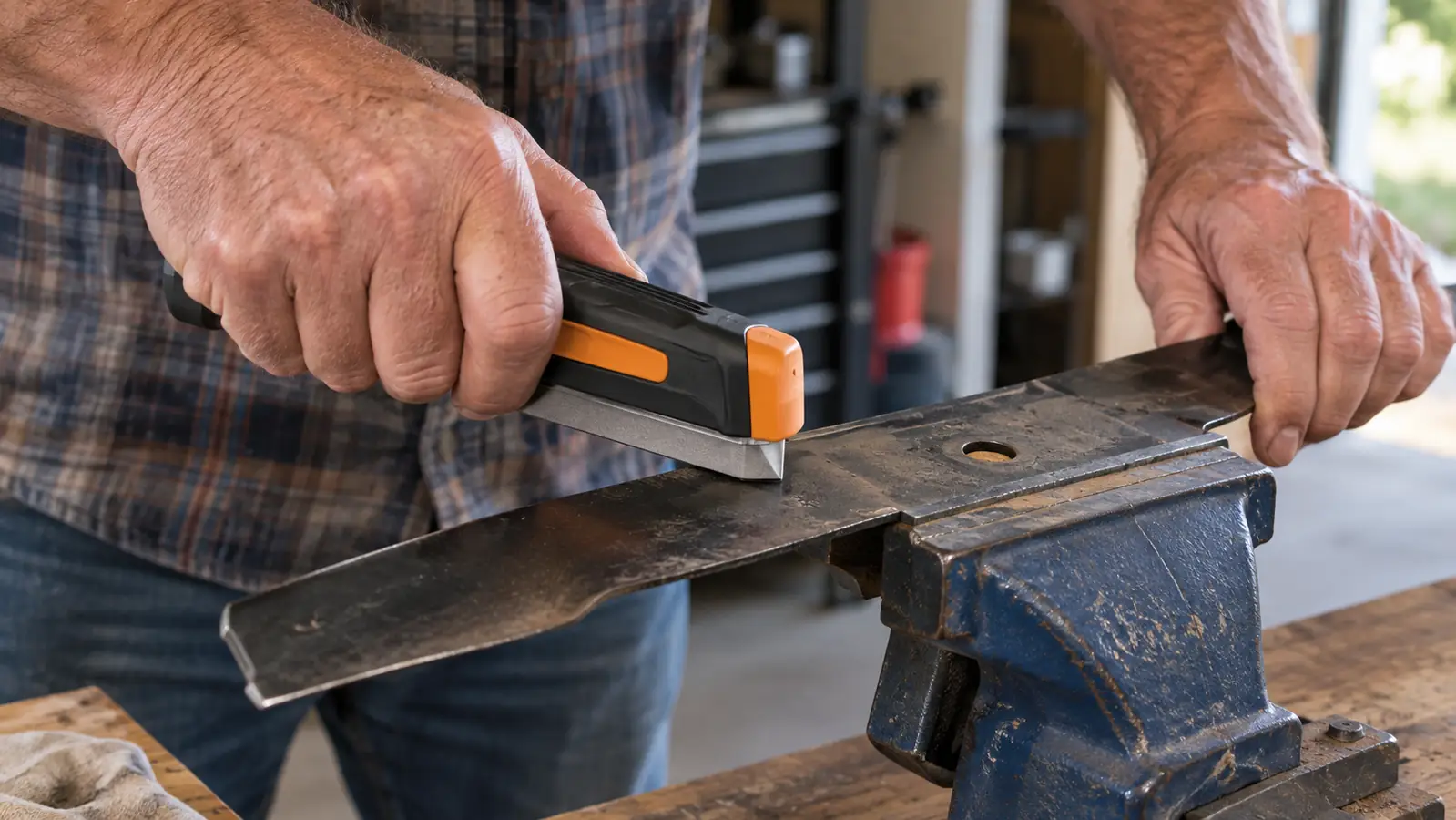
Where Oregon Wins
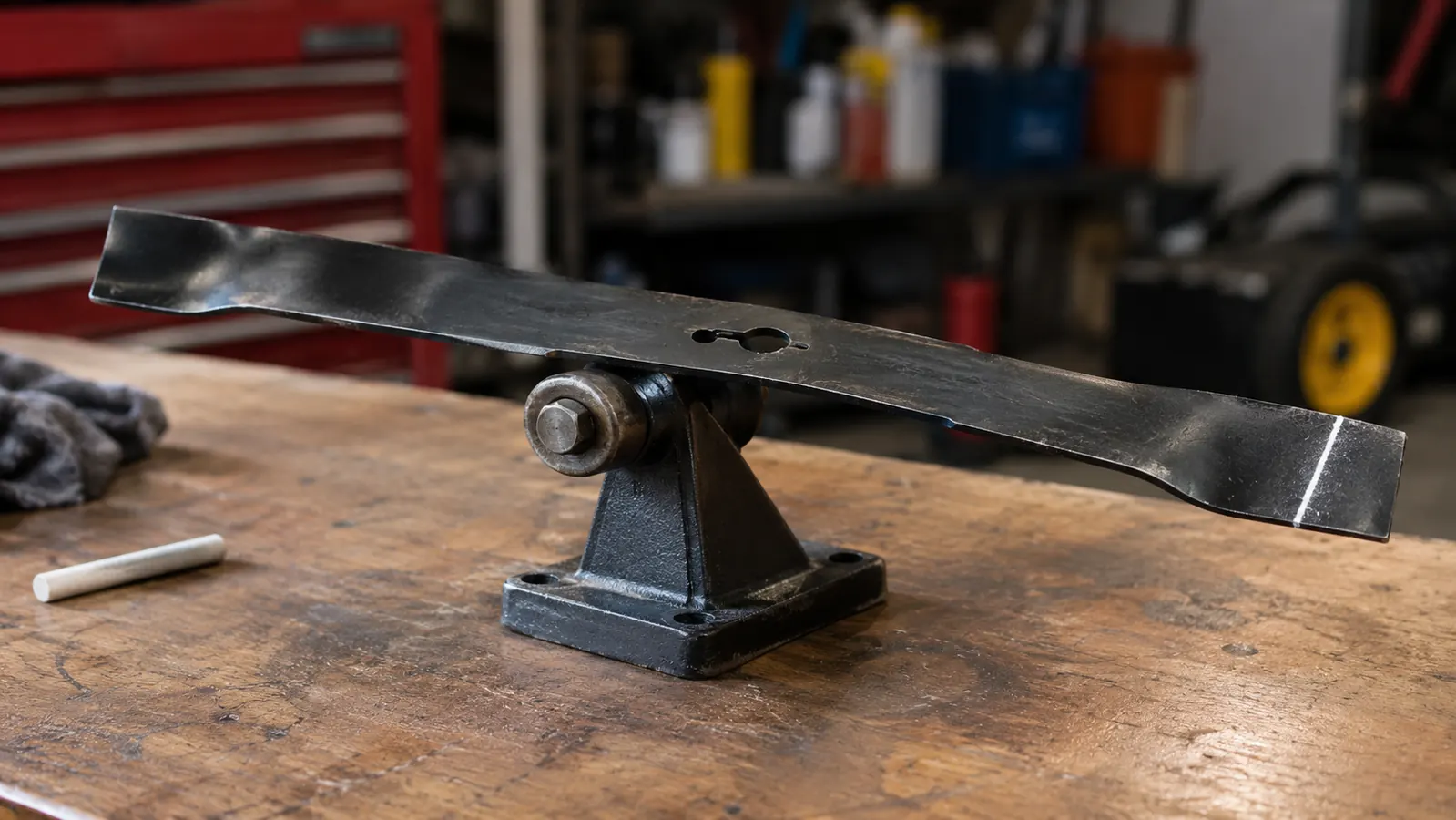
The Oregon balancer wins on price and on simplicity. It is a dedicated tool that does one job and does it well. If you already have a sharpening method you like, whether that is a bench grinder, a flap disc, or a file, you do not need the SporGain's sharpening side. You just need a quick way to check balance before you hang the blade. The Oregon balancer is the tool for that. It is also the cheaper single tool, which matters if you are on a tight budget or you already own a sharpener you are happy with.
To be specific about how the two balancers compared on my bench: they agreed. Every blade I balanced on the SporGain also sat level on the Oregon cone, and every blade that tipped on one tipped the same way on the other. That is what you want to hear, because it means you are not giving anything up on the balancing side by choosing the combo tool. Where the Oregon cone has a small edge is speed on a busy bench. You drop the blade on and read it in a second, and at the shop where we might check a dozen blades in an afternoon, that matters. At home, where I am doing three blades a few times a season, it does not.
The Oregon balancer is also what I reach for at the shop when I am doing a quick balance check on a blade that came off a customer's mower. It is fast, it is simple, and it has been on the shop bench for years. There is a reason it is the balancer you see in a lot of dealerships. But here is the honest tradeoff: it does not sharpen anything. If you do not already have a sharpening method, you are buying a balancer and then still figuring out how to sharpen the blade. That is where the SporGain combo makes more sense for a homeowner.
If you do go the Oregon route, here is how I would pair it. A bench grinder with a medium wheel is the fastest way to sharpen, but it is also the easiest way to overheat a blade, and a blade that turns blue at the edge has lost its temper and will dull fast. Take light passes and dip the blade in water between them. A flap disc on an angle grinder works too, with the same caution. A file is slow but nearly impossible to overheat, and it is what I recommend to customers who are new to sharpening. Whichever method you use, the balance check comes after, every time. That is the step the Oregon balancer is built for.
Who Should Buy Which
Buy the SporGain if you are a homeowner who sharpens your own blades and you do not already own a sharpener. You get both jobs done with one tool, you do not need a second setup on the bench, and the angle guide makes it easy to get a consistent edge. That is the situation most guys with a residential zero turn are in, and it is why the SporGain is the one I keep at home.
It also makes sense if you have more than one mower to keep up, say a zero turn and a push mower for the ditch and the fence line. The SporGain angle guide handles the shorter push mower blade the same way it handles a 54 inch deck blade, and the balancer works on both. One tool on the bench covers every blade on the property. Store it somewhere dry, wipe the grinding dust off after each session, and check that the angle setting still locks firmly at the start of each season. On mine, after a full season of use, nothing has loosened and nothing has worn out except the abrasive, which is exactly what is supposed to wear.
Buy the Oregon balancer if you already have a sharpening method you like and you just need a quick, cheap way to check balance before you hang the blade. It is a good tool, and it has earned its place on the shop bench. But for the guy who is starting from scratch, the SporGain does more for the money, and it is the one I would tell a customer to buy.
Either way, check the balance after every single sharpening. It is the cheapest step in the whole job.
Whichever tool you choose, do the job safely. Disconnect the spark plug wires and pull the key before you touch a blade, and get the mower up on a lift or ramps rated for its weight rather than tipping it on its side. Wear heavy gloves, because even a dull mower blade will open up a hand, and wear eye protection whenever you are sharpening. Mark each blade before you pull it so it goes back on the same spindle facing the same way, with the wing up toward the deck. Torque the blade bolts to the spec in your owner's manual. A blade that is sharp, balanced and properly tightened is the best thing you can do for your mower's deck.
Start with the combo and skip the second tool
The SporGain sharpener and balancer combo covers both jobs on one bench setup. That is the one I keep at home.
Amazon Check Today's Price on Amazon →