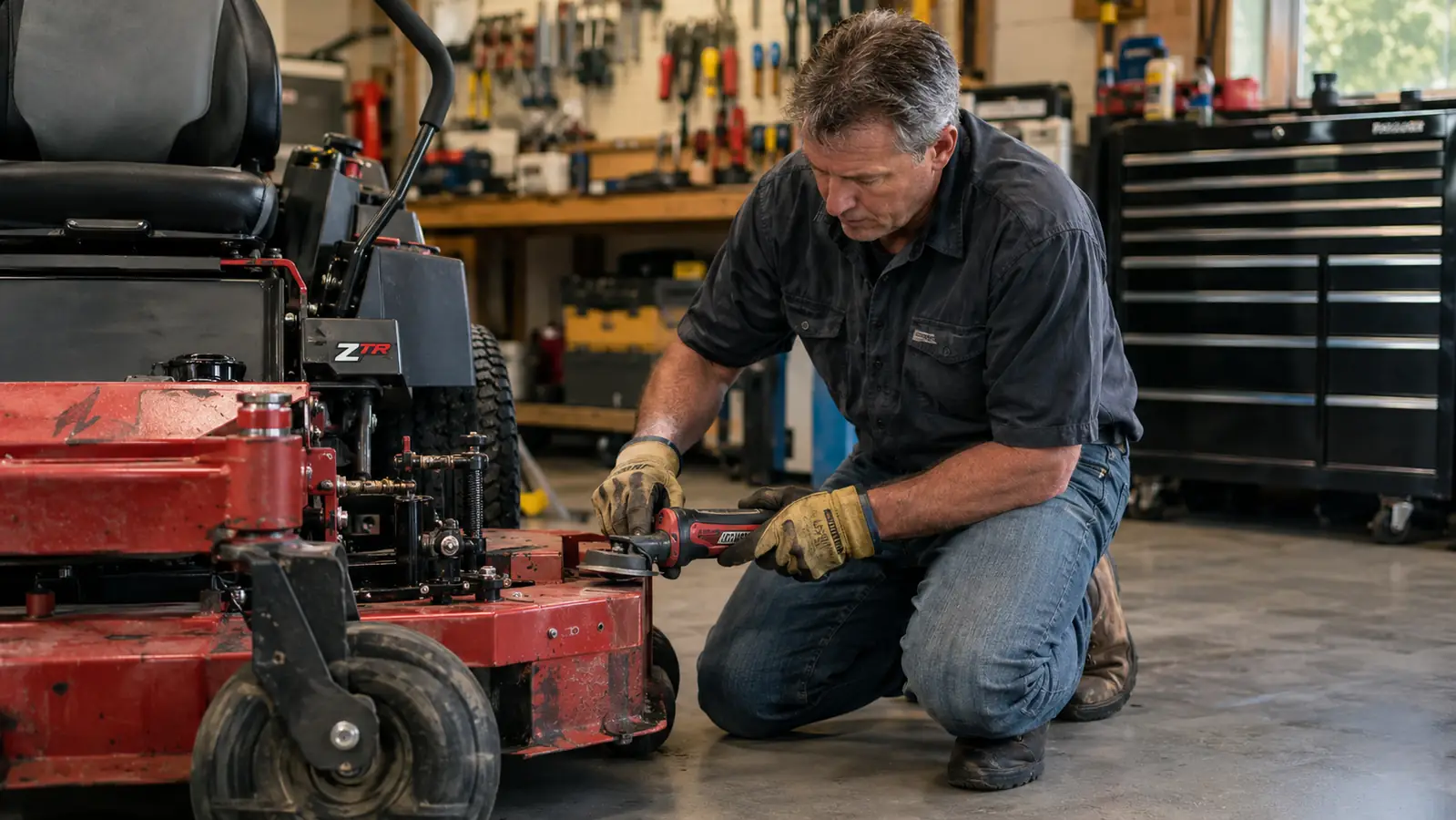
I sharpen blades for a living. Twenty years on the bench at an outdoor power equipment dealership in East Texas, and a good chunk of that time is spent pulling zero turn decks, dressing blades on a grinder, and explaining to customers why a blade that looks fine is cutting like a weed eater. So when I tell you I bought a SporGain Lawn Mower Blade Sharpener and Balancer for my own 54 inch zero turn at home, I want you to know I did not buy it because I was impressed by the marketing. I bought it because I was curious whether a handheld jig could do what I do on a bench grinder, without the mess and without the guesswork.
I ran it for a full season on my own mower, plus a few blades for customers when the shop was slow and they were in a hurry. I sharpened blades that were nicked, blades that were rounded off, and blades that had never been sharpened in the two years the owner had the mower. The short version: the SporGain sharpener is a genuinely useful tool, and it is not the tool the listing photos make it look like. Here is the honest review, including the parts that would annoy me if I were you.
The Quick Verdict
A solid, repeatable way to sharpen and balance mower blades at home, as long as you understand it is a guided hand tool, not a machine. It will not replace a grinder for badly damaged blades, but for regular maintenance it is faster, cleaner and easier to get right.
Amazon Check Today's Price →The sharpener I keep reaching for in my own garage
After a season of sharpening my own blades and a few customer blades on the side, the SporGain sharpener and balancer is the tool that actually earns its spot on my workbench. Check today's price on Amazon and see if it fits your setup.
Amazon Check Today's Price on Amazon →How I've Used It
My own 54 inch zero turn takes three blades, and on two and a half acres of St. Augustine and Bermuda I am pulling the deck about every six to eight weeks during the growing season. That is a lot of blade changes, and before the SporGain showed up I did what I have done for twenty years: I carried the blades to the shop, dressed them on the bench grinder, and balanced them on a cone. It works. It also means I am doing mower maintenance in the service bay after hours instead of in my own garage.
Before I trust any sharpening tool on my own mower, I check the blades it produced the same way I check a customer's blades at the shop. I run a thumbnail across the edge at a low angle to feel for a burr, look down the edge under a work light for flat spots that catch the light, and set each blade on a balancer. A good sharpening job leaves a clean bevel from the center to the tip with no rolled lip and no shiny rounded spots. A bad one leaves an edge that is sharp in the middle and dull near the tip, which is where the blade is moving fastest and does most of the cutting. That last part is where freehand sharpening usually goes wrong.
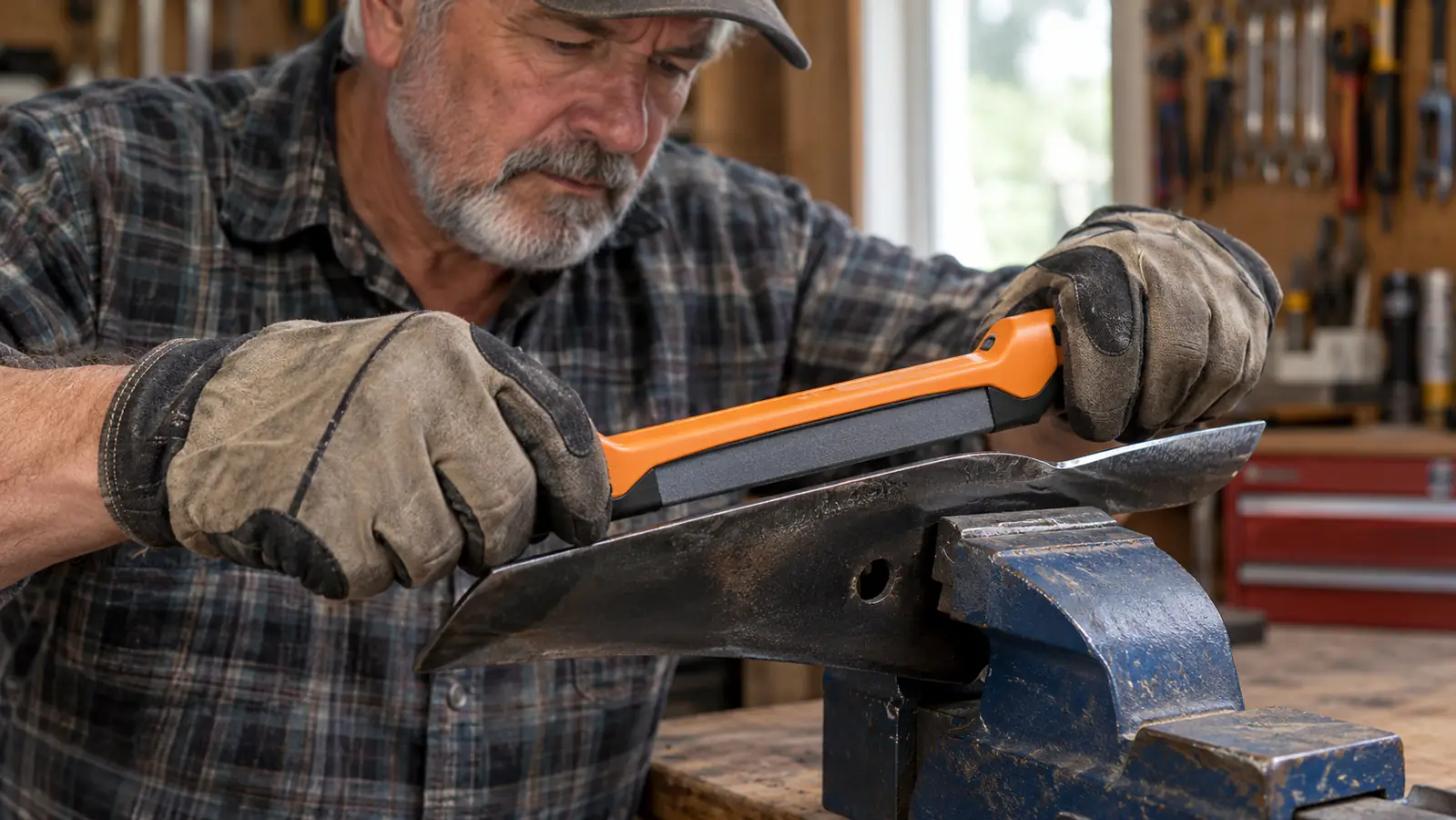
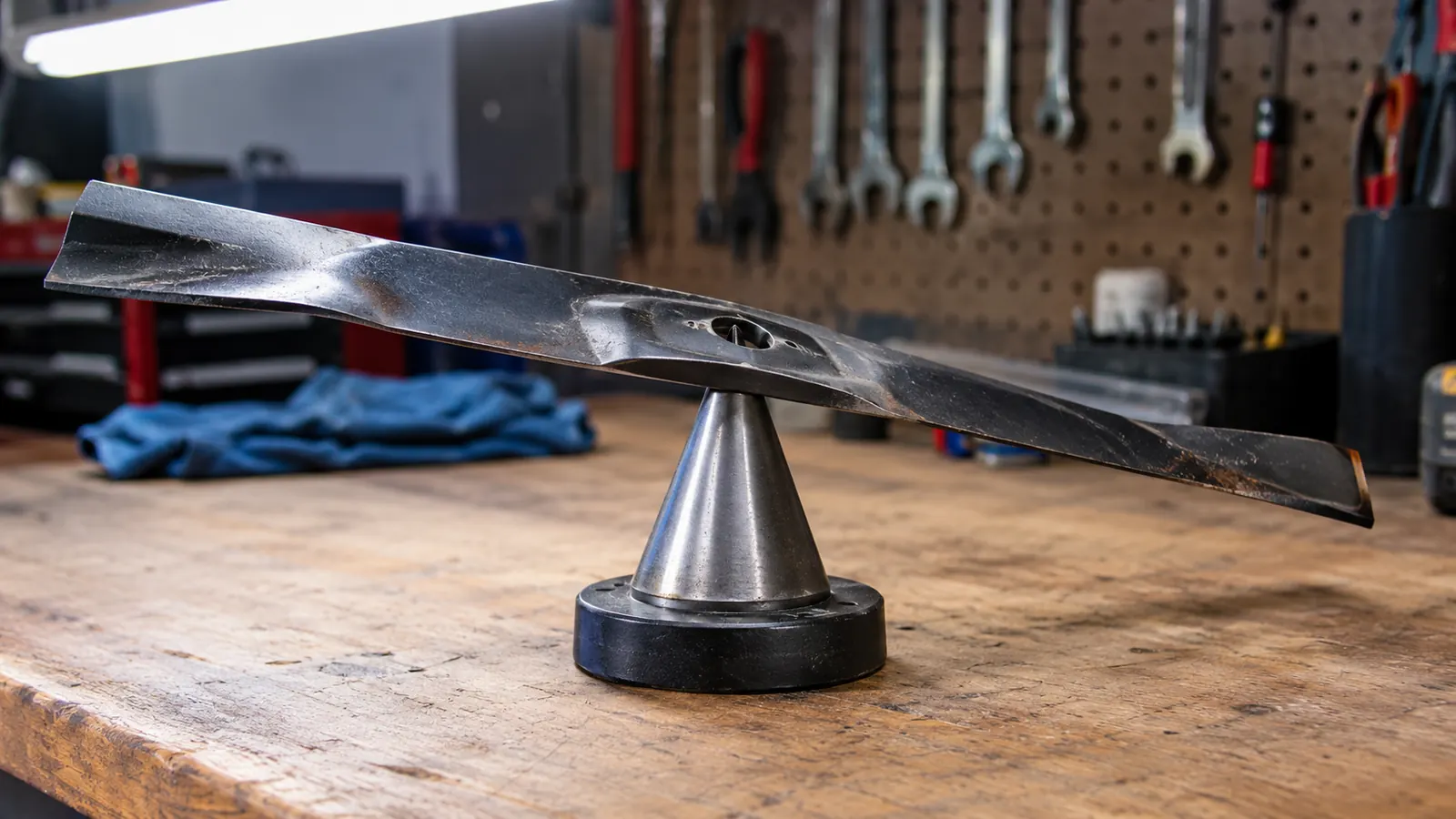
The SporGain is a handheld sharpener with an adjustable angle guide that rides along the blade edge. You clamp the blade in a vise, set the angle, and run the tool back and forth along the edge until you raise a consistent burr. Then you flip the blade and do the other side. The balancer is a cone that sits on a flat surface; you drop the blade over it and the heavy side settles to the bottom. That part is simple enough that it feels almost too simple, but it works.
I used it on blades in three conditions: blades that were just dull, blades with small nicks from hitting rocks and roots, and one set that had been run so long the edge was rolled over completely. The dull blades came back sharp in about ten minutes each. The nicked blades took longer, and I had to work the nicks out with a file first. The rolled-over set I did not even bother with; I told the customer to buy new blades, because no handheld sharpener is going to fix an edge that far gone.
What Nobody Tells You Before You Buy It
Here is the part I wish someone had told me before I ordered one. The SporGain is not a machine. It does not spin the blade for you, it does not hold the angle for you, and it does not do the work while you stand there. It is a guided hand tool, and the quality of the edge depends on you. If you are the kind of person who can run a file in a straight line, you will get a good edge. If you are not, you will get a mediocre edge and blame the tool.
The second thing nobody tells you is that the angle guide is a real feature, not a gimmick. Mower blades are not all sharpened at the same angle, and most handheld sharpeners just let you guess. The SporGain lets you set the angle anywhere in a range that covers the blades on most residential zero turns and tractors. I set mine to match the factory edge on my blades, and the cut quality was noticeably better than when I had been freehanding it on the grinder.
The third thing is the one that will annoy you: the balancer works best on a perfectly flat surface, and most garage workbenches are not perfectly flat. I ended up leveling mine with a scrap of plywood and a shim. That is not a flaw in the SporGain, it is a fact of life with any cone balancer, but it is the kind of thing you only find out after you have spent ten minutes wondering why every blade looks out of balance.
The SporGain will not fix a blade that has been run into a rock pile. It will keep a good blade sharp, and it will do it without the mess of a grinder.
How the Edge Holds Up Over a Season
The real test of any sharpening method is not how sharp the blade is when you finish. It is how long the edge lasts when the blade is back under the deck, throwing grass and dirt and the occasional pebble. I sharpened my three blades with the SporGain in early spring, ran them for about six weeks, and pulled them to check. The edge was still cutting cleanly, with only light rounding on the leading edge. That matches what I get from a grinder on the same blades.
On my lawn, I judge that by looking at the grass two days after a cut. A torn blade of St. Augustine turns white and then brown at the tip, and on a whole lawn that shows up as a dull, slightly gray cast when the sun is low. After a SporGain sharpening, the tips stayed green and the color held for the full week between mows. By the fifth or sixth week the cast started to creep back in, which told me it was time to pull the blades again. That four to six week rhythm is about what I tell customers on a residential zero turn in East Texas, and the SporGain fit into it without any trouble.
I also paid attention to the cut quality on my St. Augustine, which is the grass that shows a dull blade fastest. A dull blade tears the tips and leaves a brown cast across the lawn within a day or two. With the SporGain edge, the cut stayed clean through the whole six week window. I did not see the tip browning I used to get when I pushed blade changes too long.
One honest note: the SporGain edge is not quite as aggressive as the edge I get from a fresh grinding wheel. It is close, close enough that I would not be able to tell the difference in the grass, but if you are the kind of person who can feel the difference between a 25 degree edge and a 30 degree edge, you will notice. For the other 99 percent of us, it is a non issue.
The Balancer Is Half the Value
I have balanced more blades than I can count, and I will tell you plainly: most home sharpeners skip the balancing step, and most home sharpened blades are out of balance. An out of balance blade will vibrate the spindle, wear the bearings, and eventually cost you a spindle assembly that is a lot more expensive than the sharpener you were trying to save money on.
The SporGain balancer is a simple cone, and it does the job. You drop the blade over the cone, wait for it to settle, and the heavy side points down. Then you take a little metal off the heavy side with the sharpener or a file, and check again. I balanced all three of my blades this way, and the mower ran noticeably smoother at full throttle. No more vibration you can feel through the floorboard.
The balancer is also the reason I would tell a homeowner to buy the SporGain kit instead of a cheaper sharpener that does not include one. A sharpener alone gets you a sharp blade that may still vibrate. The SporGain gets you a sharp blade that is also balanced, and that is the difference between a mower that runs smooth and a mower that slowly eats its own spindles.
Where It Struggles
I am not going to pretend the SporGain is the right tool for every situation, because it is not. If you are sharpening blades for a living, or if you are sharpening blades that have been abused, you still want a bench grinder. The SporGain is a maintenance tool, not a repair tool. It will keep a good blade good. It will not bring a bad blade back from the dead.
It also takes longer than a grinder. I can dress a blade on the bench grinder in about three minutes. With the SporGain, I am looking at ten to fifteen minutes per blade, most of that time spent making slow, consistent passes. That is fine for a homeowner doing three blades every six weeks. It would drive me crazy if I had to do it for a living.
To put numbers on that from my own garage: on the shop grinder I can dress and balance a 54 inch deck's three blades in about fifteen minutes. With the SporGain at home it took me closer to twenty five the first few times, and about twenty once I had a feel for the angle guide. For a homeowner doing this five or six times a season, that is an extra half hour or so over a whole year. In exchange you get a consistent bevel and no risk of overheating the edge, which is the mistake I see most often on blades that customers have sharpened on a bench grinder at home. A blade that turned blue at the edge has lost its hardness and will not hold an edge again.
And there is the learning curve. The first blade I did with the SporGain came out with an uneven edge because I was pressing too hard and moving too fast. The tool wants a light touch and a steady pace. Once I slowed down, the edges came out consistent. That is not a flaw in the tool, but it is a reality you should know before you buy one: your first blade will not be your best blade.
What I Liked
- Consistent edge angle once you set the guide, no guessing
- Balancer included, so you can fix vibration at the same time
- No sparks, no grinding dust, no mess in the garage
- Simple enough for a homeowner who has never sharpened a blade
- Compact, stores in a drawer, no cord, no motor to wear out
Where It Falls Short
- Slower than a bench grinder, about ten to fifteen minutes per blade
- Won't fix badly nicked or rolled over blades, you need a file or new blades
- Learning curve on pressure and pace, the first blade will be uneven
- Balancer needs a truly flat surface to be accurate
- Not a repair tool, it is a maintenance tool
Who This Is For
The SporGain is for the homeowner who wants to sharpen their own blades, wants to do it right, and does not want to set up a grinder in the garage. It is for the person who has been paying the dealership to sharpen blades and realizes they can do it themselves in the same amount of time it takes to load the mower on a trailer. It is for the person who wants a sharp, balanced blade every time, without the mess and without the guesswork.
It is also a good fit if you have been paying a shop to sharpen your blades and want to stop. There is nothing wrong with paying a shop, and we are glad for the work, but a lot of owners only bring blades in once a year when they really need it every month or so in the growing season. Having the SporGain on your own bench means you sharpen on the schedule the grass needs, not the schedule your errands allow. Pair it with heavy gloves, eye protection, a vise and a safe way to get under the deck, and you have everything you need. On my own 54 inch zero turn, that is how I keep the cut clean from April through October.
Who Should Skip It
Skip the SporGain if you are a professional sharpening blades every day, or if your blades regularly hit rocks and come back with serious nicks. Skip it if you expect a machine to do the work for you, because this is a hand tool and your results depend on your technique. And skip it if you are the kind of person who will sharpen a blade once and then let it go for two years, because the SporGain only helps if you actually use it.
The honest bottom line from a guy who sharpens blades for a living
The SporGain sharpener and balancer is a maintenance tool that does its job well, as long as you know what it is and what it is not. If that sounds like your situation, check today's price on Amazon and see if it earns a spot on your workbench.
Amazon Check Today's Price on Amazon →