
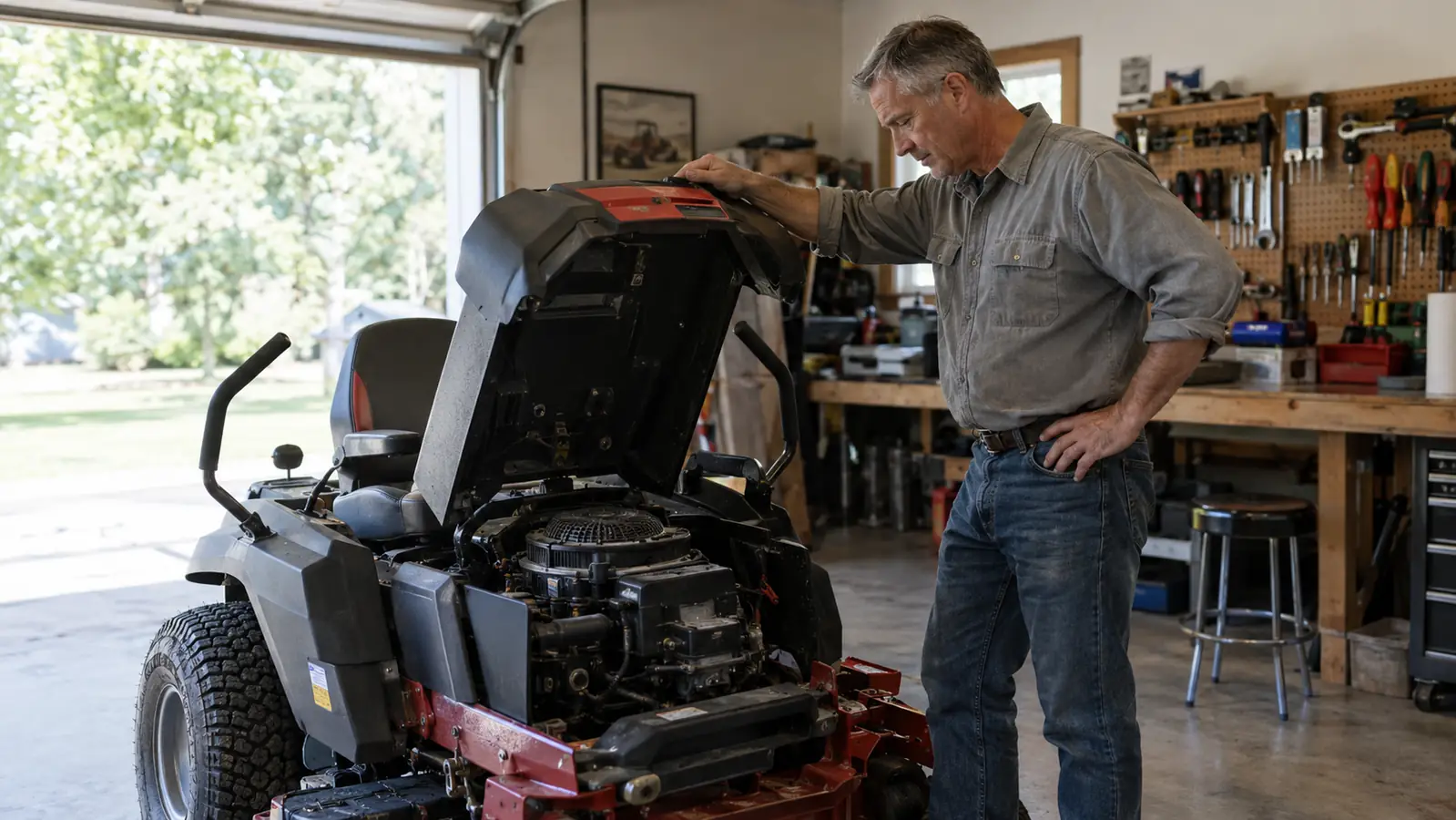
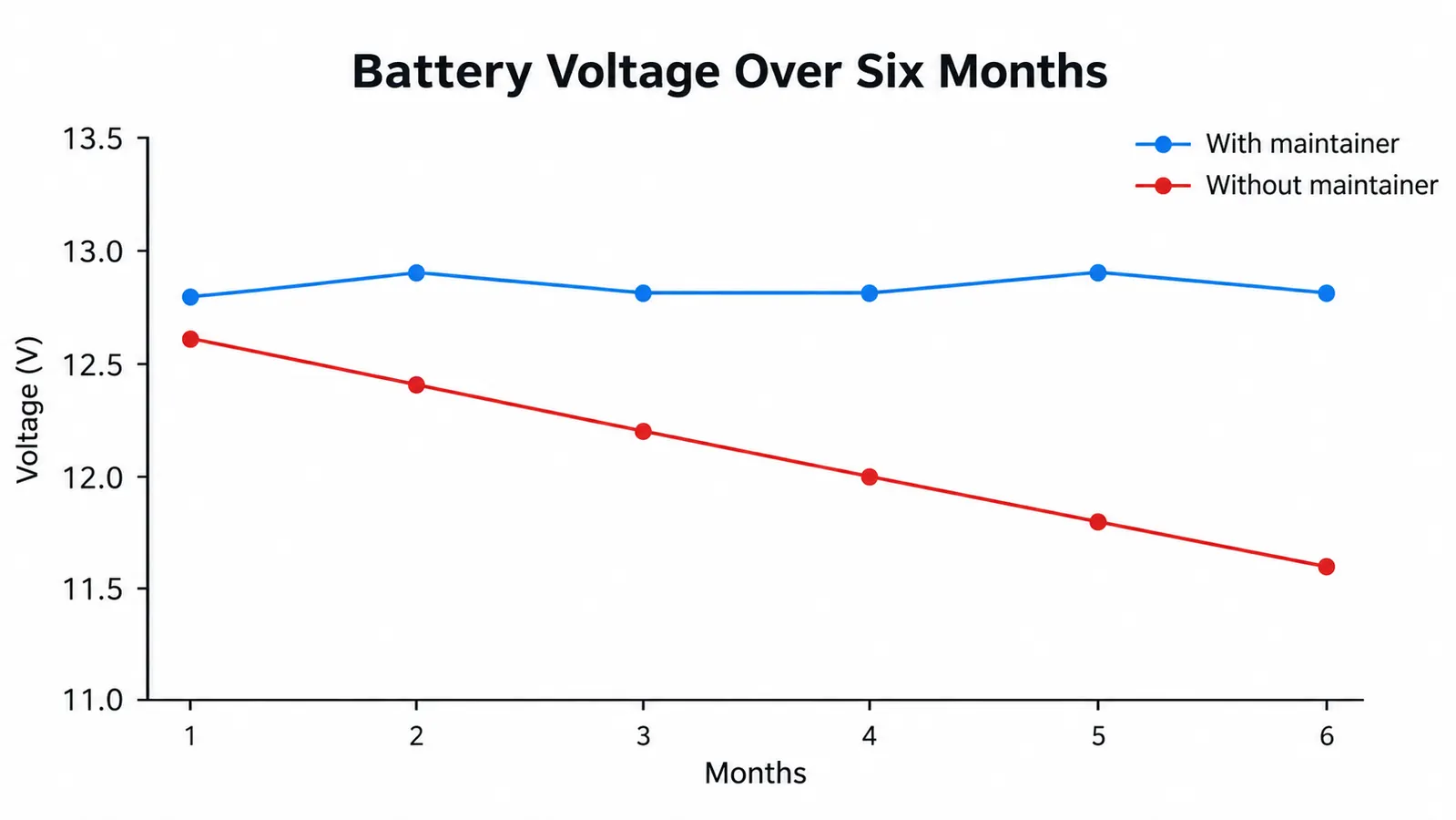
Every spring the same two or three zero turns show up at our shop on a trailer with a dead battery. The owner swears the battery was fine when they parked it in October. It was. That is exactly the problem. A fully charged lead acid battery left sitting for four or five months will drain itself, sulfate the plates, and by March it will not take a charge worth keeping. You do not have a bad battery. You have a battery that sat. I have been a service tech for over 20 years, and I run a 54 inch zero turn at home on two and a half acres of St. Augustine and Bermuda, so I have killed my share of batteries the same way. The fix is not a bigger battery. The fix is a Battery Tender Junior and a five minute routine before you park it for the season.
This guide walks through the exact steps I use on my own mower at home and what I tell customers at the counter. It takes longer to read than to do. Once you have done it a couple of times, the whole thing is maybe ten minutes with a wrench and a Battery Tender Junior.
The cheap part that ends dead-battery springs for good
A Battery Tender Junior is the maintainer I recommend more than any other at the shop. It is automatic, it will not overcharge, and it pays for itself the first spring you do not buy a new battery.
Amazon Check Today's Price on Amazon →Step 1: Clean the terminals and check the cables before you store it
Corrosion on the terminals is the number one reason a maintainer underdelivers. The Battery Tender Junior can only push its 750 milliamps through a clean connection. If the post is crusted over, the voltage reading looks fine but the current barely moves. I use a wire brush or a terminal cleaning tool, then a light coat of dielectric grease on the post before I reconnect. That takes two minutes and it means the maintainer is actually doing its job all winter.
While you are in there, check the cable ends for cracks and make sure the bolts are snug. A loose ground cable is the other classic cause of a no-crank in spring. I have had customers replace a battery, a starter solenoid, and a switch before I found a ground cable that had worked itself loose over a season of vibration. Tighten it, clean it, and move on.
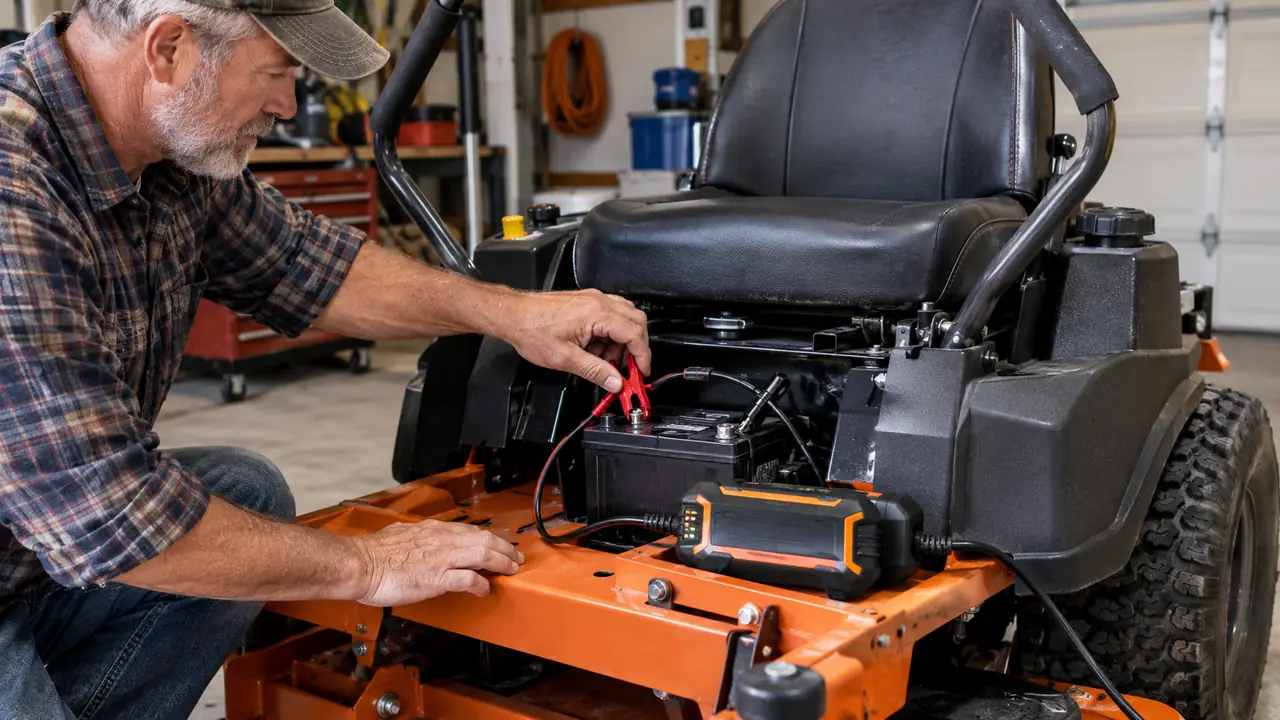
One note on the Battery Tender Junior specifically: it comes with ring terminals and alligator clips. For a zero turn that sits all winter, I use the ring terminals bolted to the battery posts. That way the maintainer is a two second hookup instead of a clip-on job every time. I keep the ring terminals on the posts all winter and just unplug the cord at the connector when I need the mower.
Step 2: Top off the battery with distilled water if it is a serviceable type
If your zero turn has a maintenance free battery, skip this step. If it has caps you can open, check the electrolyte level before you put the maintainer on. The plates need to be covered. I top off with distilled water only, never tap water. Tap water carries minerals that shorten battery life, and I have seen it cause white crust on the plates in less than a year.
Do not overfill. The electrolyte expands when the battery charges, so fill to the lower mark or just above the plates. Overfilling makes a mess and can push acid out of the vents onto the frame. I have cleaned that corrosion off more than one mower, and it is not a job you want to do twice. On my own mower at home I check the level in October and again in January, and it has never needed more than a few ounces.
This is also the moment to look at the battery's age. If it is five years old and already struggling in fall, a maintainer will not bring it back. It will keep it from dying over the winter, but the honest answer is that you are on borrowed time. I tell customers the same thing I do at my own bench: if the battery is old, replace it now and maintain the new one from day one. A battery that tests weak in October will test dead in March, and no maintainer changes that.
Step 3: Hook up the maintainer, not a trickle charger
This is the step that separates a battery that lasts five years from one that lasts two. A trickle charger pushes a fixed current all the time. Leave it on all winter and it will overcharge, boil the electrolyte, and cook the battery. A maintainer like the Battery Tender Junior is automatic. It charges until the battery is full, then drops to a float voltage that keeps it topped off without cooking it. That is the whole difference, and it is why I do not recommend leaving a trickle charger on anything for months.
The Battery Tender Junior is rated at 750 milliamps, which is plenty for a zero turn battery sitting over winter. It is not a charger you would use to bring a completely dead battery back to life quickly, and I do not pretend otherwise. For that job you want a bigger unit. For maintaining a healthy battery through the off season, 750 milliamps is exactly right. It is also small enough to hang on the mower frame or sit on the floor next to the tire.
Hook it up positive to positive, negative to negative, then plug it in. The light on the unit tells you what it is doing. When it is charging, the light is on. When the battery is full, the light goes to a steady state that means it is floating. I check mine once a month and it is almost always already in float by the time I look. Last January I walked out to the garage on a 28 degree morning, and the light was already in float before I got the door fully open.
Step 4: Run the mower once a month, even in winter
A maintainer handles the battery, but a zero turn has other parts that like to move. I start my mower at home once a month through the winter, let it run long enough to get up to operating temperature, and work the hydrostatic drives back and forth a few times. That keeps seals lubed, keeps fuel from going stale if you did not drain it, and it gives me a chance to hear if anything is off before the season starts.
You do not need to mow anything. Just let it warm up, move the deck up and down, turn the wheels lock to lock, and shut it down. Ten minutes once a month. If you would rather not run it, at least roll it forward and backward a few feet so the tires are not sitting on the same spot all winter. Flat spots on turf tires are real, and they thump for the first hundred feet of the first mow.
If the mower has been sitting and the battery is already dead, do not just throw the maintainer on and hope. Charge the battery with a real charger first, then put the maintainer on. The Battery Tender Junior will eventually bring a low battery up, but it is a maintainer, not a jump box. Give it a full charge, then let the maintainer keep it there. I have a 10 amp charger on the bench at home for exactly that job, and it has saved me twice when I let a battery sit too long.
Step 5: Do a spring check before the first mow
When the grass starts growing, do not skip the five minute check. Confirm the maintainer light is in float, disconnect it, and recheck the terminal bolts. Then crank the mower and let it run for a few minutes before you cut. A battery that has been floated all winter should crank like it did in October. If it does not, you caught the problem in the garage instead of at the back of the yard.
I also check the tire pressure and give the blades a quick look at the same time. It is the same five minutes, and it means the first mow of the season is a mow, not a repair session. The customers who do this routine are the ones who do not show up on our trailer in March. Last spring I had a customer call in late March saying his mower would not crank, and it turned out he had never plugged the maintainer in. The unit was fine. The habit was the missing part.
If you stored the mower with fuel in the tank, add a fuel stabilizer before the first run if you did not do it in fall. Stale fuel is the other big spring no-start, and it is a ten second pour that saves a carburetor cleaning. The battery was the problem you came here for, but the fuel is the problem you will find next week.
What Else Helps
A maintainer is the main thing, but a few cheap habits make the whole system more reliable. Keep the battery terminals clean and greased. Store the mower with a full battery, not a half charged one, because a lead acid battery sitting partially discharged is what sulfates. If your zero turn has a battery disconnect switch or you can pull the negative cable, that is fine, but the maintainer does the job better because it keeps the battery at full charge instead of just stopping the drain. And if you are replacing a battery anyway, buy one with a good warranty and write the date on the case with a marker. You will thank yourself in three years when you are trying to remember how old it is.
One more thing I tell every customer: buy the maintainer before you need it. The Battery Tender Junior is cheap enough that it is an impulse buy, and it is the difference between a five minute hookup in October and a service call in March. I have one on my own 54 inch zero turn at home, and I have sold more of them than I can count over the counter. The ones that come back are almost always the ones that were never plugged in.
A trickle charger will cook a battery if you leave it on all winter. A maintainer floats it at full charge. That is the whole difference, and it is why I tell customers to throw the trickle charger away.
Park it for winter the right way, once
Hook up a Battery Tender Junior in October and you will not be the one loading a dead zero turn onto a trailer in March. It is the cheapest insurance you can bolt to a battery.
Amazon Check Today's Price on Amazon →