
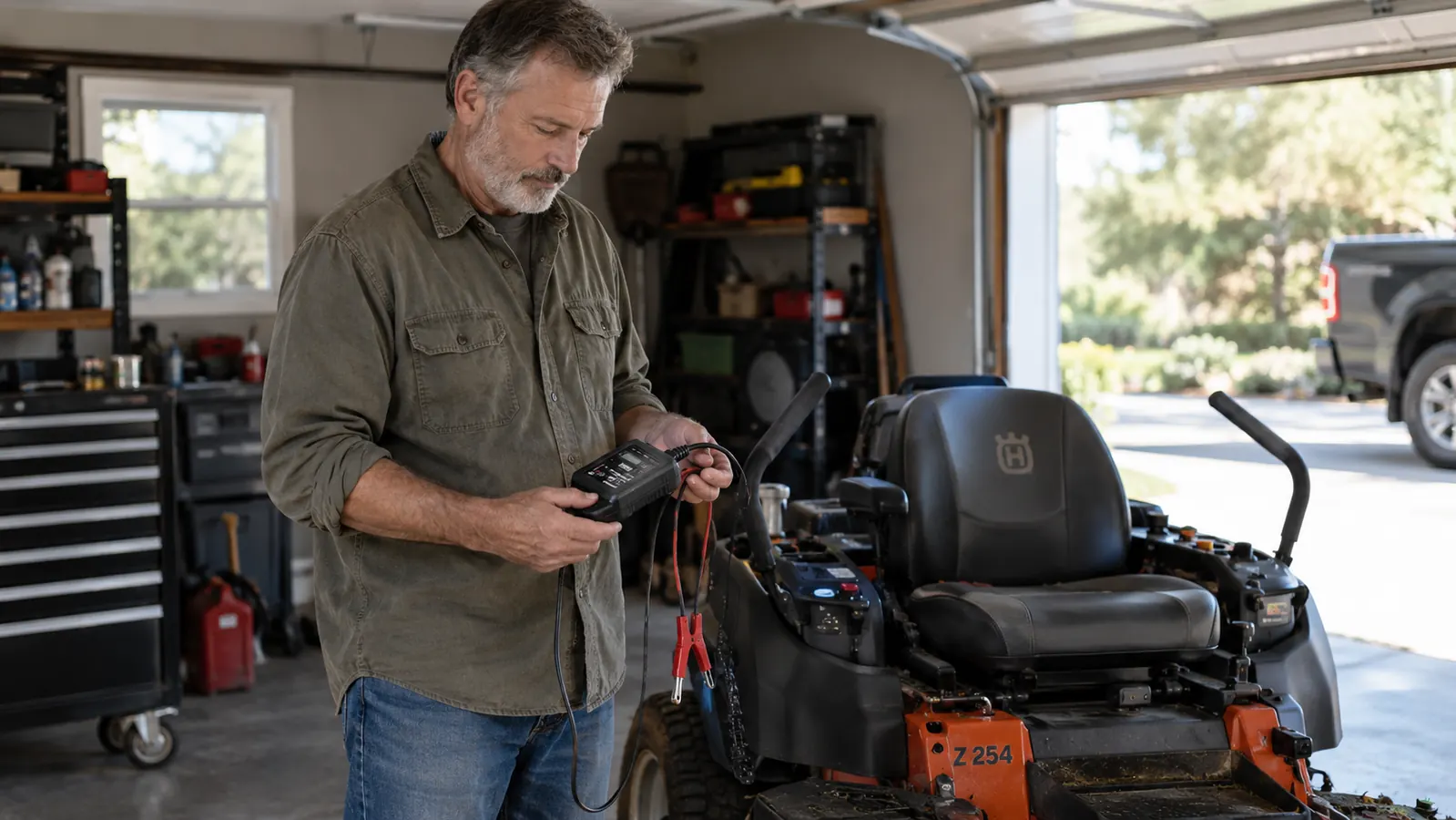
If you run a zero turn, you already know the drill. You park it in the back of the shop in October, tell yourself you'll fire it up in a couple of weeks, and then February rolls around and the battery is flat as a board. I've been on the bench at an outdoor power equipment dealership in East Texas for over 20 years, and I've lost count of how many customers drag a dead mower up to the bay every spring. The fix is simple: put a maintainer on it before it sits. The question is which one, and the two I get asked about most are the Battery Tender Junior and the NOCO Genius1.
I've run both on my own 54 inch zero turn at home, and I've bench-tested both on the shop's dead batteries. Short answer: the Battery Tender Junior is the one I'd buy for a mower that sits for weeks at a time. It's simpler, it's been doing this job for decades, and it's all a mower battery actually needs. The NOCO Genius1 is a fine charger with more features, but most of those features are aimed at people who need to revive a deeply discharged car battery, not maintain a lawn mower battery over the winter.
Before the comparison, a quick word on why a zero turn battery needs this at all. Most residential zero turns run a small 12 volt battery, and it does two jobs: it spins the starter and it runs the safety interlocks and the charging circuit. Over a long off season, a battery left connected to the mower slowly drains through the clock, the ignition module and plain self discharge. Once a lead acid battery sits below full charge for weeks, sulfate builds up on the plates and the battery never comes all the way back. That is the battery that clicks instead of cranks in March. A maintainer prevents it by holding the battery at a full, safe float all winter.
| Battery Tender Junior | NOCO Genius1 | |
|---|---|---|
| Output | 750mA, sized for powersports and mower batteries | 1A, slightly faster for larger batteries |
| Charging behavior | Simple 4-step automatic charge and maintain | 8-step smart charging with more modes |
| Ease of use | Plug in, connect, walk away. No modes to pick | More modes and buttons to learn |
| Winter storage | Built for long-term float maintenance | Also maintains, but with more settings than you need |
| Best for | Mowers, ATVs, motorcycles that sit between uses | Cars, trucks, and deeply discharged batteries |
Where the Battery Tender Junior Wins
The Battery Tender Junior wins on the one thing that matters most for a mower battery: it's boring. You connect the ring terminals to the battery, plug it in, and it does its job without asking you anything. There's no mode button to press, no light sequence to decode, no manual to keep in the garage. When the battery is full, it drops to a float charge. When the battery drains a little, it tops it back up. That's the whole job, and it does it every single day of the winter without complaint.
That simplicity shows up in daily use. I leave the Battery Tender Junior pigtail connected to my mower's battery terminals all season, tucked up beside the battery where it cannot catch on anything. When I park the mower for the winter, I plug the Junior into the pigtail and the wall, the light goes green within a day, and I do not think about it again until spring. There is no mode to pick, no button to press and no setting to get wrong. For an owner who is not a tech person and just wants the mower to start, that is the whole point.
It also wins on price. The Battery Tender Junior is usually a few dollars cheaper than the NOCO Genius1, and for a mower battery that's money you don't need to spend. A residential zero turn battery is a small, simple lead-acid battery. It doesn't need a 1A charger with eight steps and a repair mode. It needs a steady, gentle float charge that keeps the plates from sulfating while the mower sits. The Battery Tender Junior is exactly that, and it's been that for so long that the design is basically proven.
Let me give you a concrete example from my own garage. Last October I parked my 54 inch zero turn after the final cut of the season, hooked the Battery Tender Junior to the battery with the ring terminals, and ran the lead out through the gap in the frame so the hood would close flat. I checked it once around Thanksgiving, once at Christmas, and once in late January. Every time, the green light was steady and the battery read 12.7 volts with my multimeter. The mower fired on the first crank in March, and I didn't have to put a charger on it once. That's the whole argument for this unit in one paragraph.
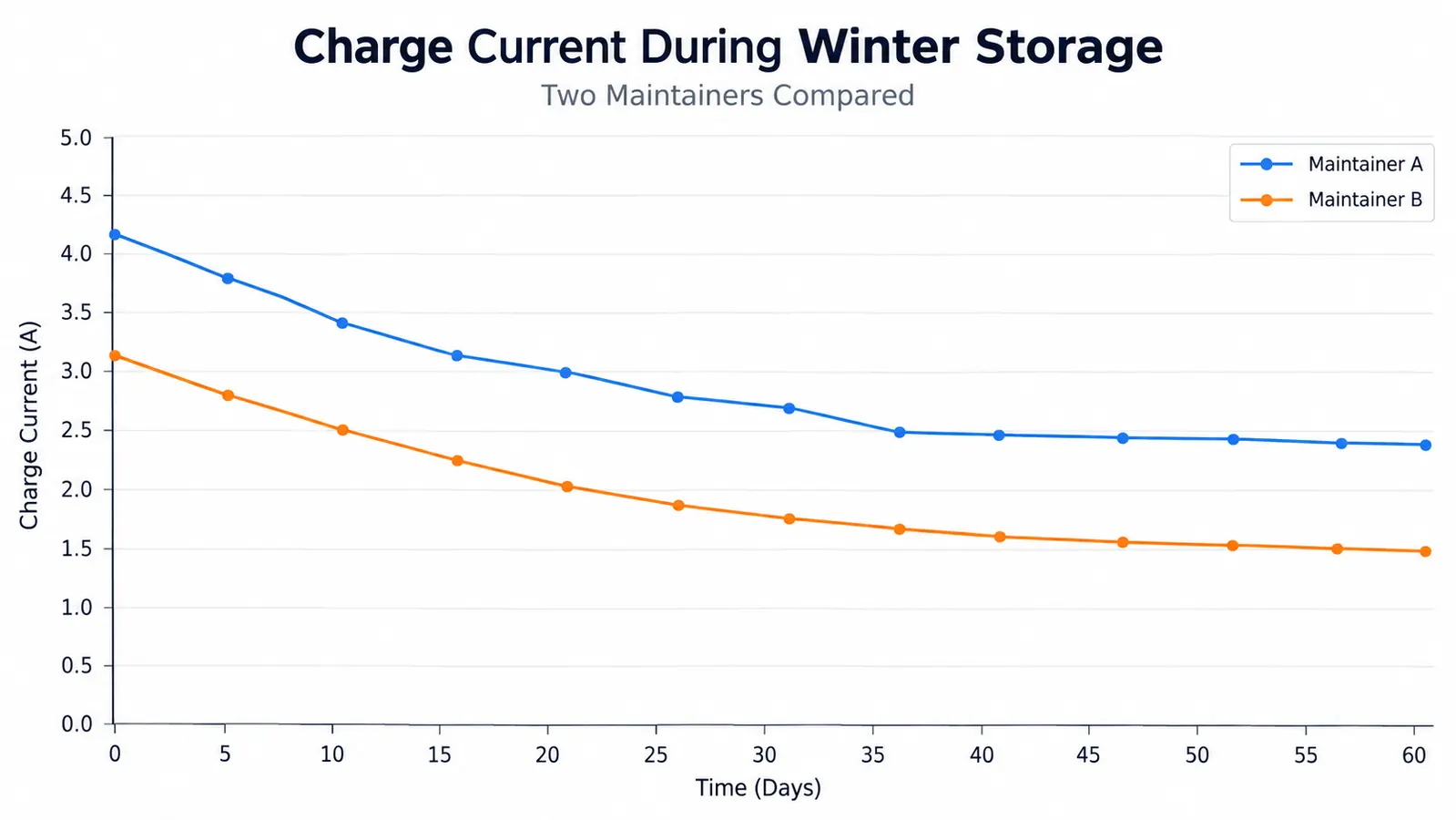
The other thing I like is that the Battery Tender Junior doesn't care if you leave it connected for four months straight. The float stage is genuinely a float stage, not a trickle charge that keeps pushing current and slowly boils the battery dry. I've seen what a cheap trickle charger does to a battery left on it all winter: the cells dry out, the case bulges, and the customer comes in April with a battery that's ruined even though it was 'on the charger' the whole time. The Battery Tender Junior doesn't do that. It measures, it tops up, it backs off. That's the behavior you want on a battery that's going to sit.
The 750 milliamp output is the part some people worry about, so let me address it. It is a slow rate on purpose. A maintainer is not meant to bring a dead battery back in an hour. It is meant to top off a healthy battery and then hold it at float for months without overcharging it. On a small zero turn battery, a slow, steady rate is gentle on the plates and keeps the battery cool. If your battery is fully dead, charge it properly first or have your dealer test it. If it is healthy and you want it to stay healthy over the winter, the Junior's rate is exactly right.
The maintainer I'd put on my own mower
If your mower sits for more than a couple of weeks, the Battery Tender Junior is the simplest way to make sure it starts in the spring. No modes, no menus, just plug it in and forget it.
Amazon Check Today's Price on Amazon →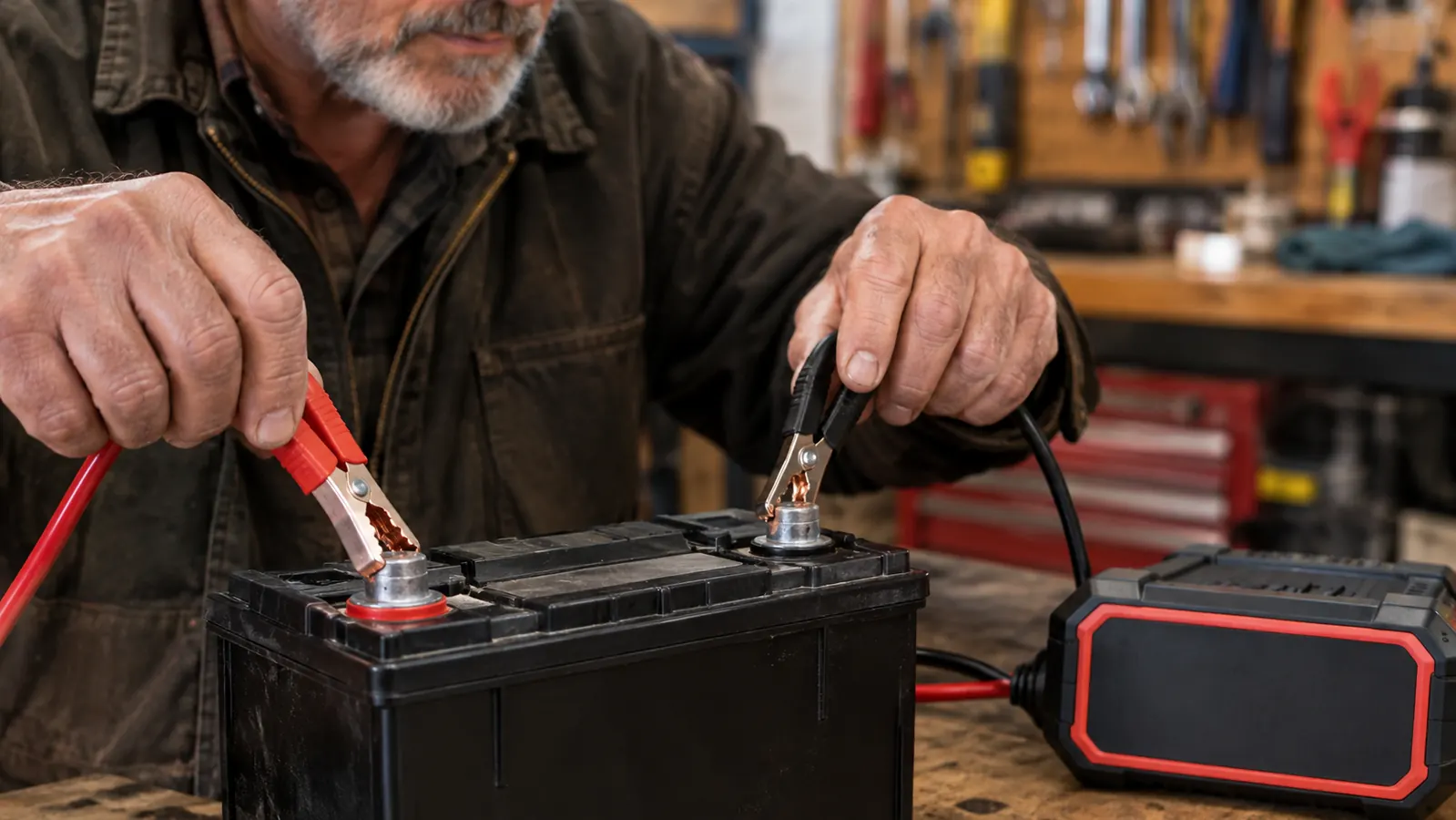
Where the NOCO Genius1 Wins
I'll give the NOCO Genius1 its due. It's a genuinely good charger, and it wins in two places. First, it charges faster. At 1A it will bring a dead battery back to life quicker than the Battery Tender Junior's 750mA, which matters if you're reviving a battery that's been sitting dead for months. Second, it has more features: a repair mode, a cold-weather mode, and the ability to handle larger batteries. If you're the kind of person who wants one device that can maintain the mower battery, jump-start a car battery, and keep a truck battery topped up, the NOCO is the more versatile tool.
The NOCO is also the more capable tool on paper. It puts out a little more current and has more modes, including one for colder weather, and it will show you more about what it is doing. For someone who maintains a fleet of small engine batteries, or who likes to know exactly what state a battery is in, those features are worth having. For a homeowner with one zero turn in an East Texas garage, I found I never used them. That is not a knock on the NOCO. It just means you are paying for capability you may never need if your mower sits in a mild climate for the off season.
The NOCO also wins on build quality in one specific way: the clamps feel more substantial, and the unit itself has a more modern, rugged case. I've dropped both on the shop floor, and the NOCO shrugged it off. The Battery Tender Junior is built fine, but it's an older design and it shows. If you're hard on your tools, the NOCO will take more abuse.
Here's a real test from the shop that made me respect the NOCO. A customer brought in a riding mower that had sat dead in a shed for about a year and a half. The battery read 2.1 volts, which is about as dead as a 12V battery can get. I hooked up the NOCO Genius1 and let it run through its recovery routine. It took the better part of a day, but it brought that battery back to a point where the mower started and the customer got another season out of it. The Battery Tender Junior would not have done that. Its job is to maintain a healthy battery, not resurrect a corpse. If you regularly deal with batteries that have been sitting dead for months, that recovery ability is a real advantage.
The NOCO's cold-weather mode is also worth mentioning if you're north of where I am. I've had customers in the panhandle tell me the Genius1 handles a battery in an unheated shed better than the Battery Tender Junior does when temperatures drop below freezing. I can't verify that from my own bench in East Texas, but it matches the spec sheet, and it's a fair point in the NOCO's favor if your winters are genuinely cold.
Who Should Buy Which
Buy the Battery Tender Junior if you have one mower, or a mower and an ATV, and you just want it to start in the spring. It's the set-and-forget option. Buy the NOCO Genius1 if you want one charger that can also handle a car or truck battery, or if you regularly deal with batteries that have been dead for a long time and need reviving rather than just maintaining.
Whichever one you buy, hook it up correctly. Connect the positive clamp or ring terminal to the positive post first, then the negative, and plug the maintainer into the wall last. Disconnect in the reverse order. Charge in a ventilated space away from fuel cans and anything that sparks, and do not charge a battery that is cracked, swollen or frozen. If the mower is stored for the winter, check that the maintainer light shows a full charge a day or two after you set it up, then leave it alone. Come spring, unplug it, check the terminals for corrosion, and the mower should start on the first turn of the key.
For my own 54 inch zero turn, I use the Battery Tender Junior. It's the right tool for the job, and it's the one I recommend to customers who ask what they should put on their mower for the winter. The NOCO is a better charger. The Battery Tender Junior is a better mower battery maintainer.
In more than twenty years on the service counter, the dead battery in spring is the single most common call we get when the weather turns warm. Almost every one of them could have been prevented with an inexpensive maintainer and a pigtail. Either of these two tools will do that job. The Junior does it with less to think about, which is why it is the one on my own mower.
Set it and forget it this winter
The Battery Tender Junior is the simplest way to keep your mower battery ready to go. Connect it once, and it handles the rest.
Amazon Check Today's Price on Amazon →