

Every spring, the same three calls roll into the shop. A customer loads a zero turn onto a trailer, drives twenty minutes, and the battery is dead when they get here. Nine times out of ten, the mower sat in a shed since October with a battery that was never on a maintainer. I have been on the bench for over twenty years, and I have lost count of how many of those batteries we could have saved. The Battery Tender Junior is the tool I tell those customers about, and it is the one I run on my own 54 inch zero turn at home. This is the honest version of that recommendation, including the parts that are not as impressive as the box makes them sound.
I want to be clear about what this review is and is not. I am not a lab. I did not measure charge curves with a scope. I am a service tech who has replaced a lot of batteries, bench-tested a lot of chargers, and used the Battery Tender Junior through several winters on my own equipment. What follows is what I tell customers at the counter, with the sales pitch stripped out.
The Quick Verdict
The Battery Tender Junior is the right tool for keeping a zero turn battery alive through the off season, as long as you understand it is a maintainer, not a charger for a dead battery.
Amazon Check Today's Price →Keep your battery from dying in the shed this winter
The Battery Tender Junior is the maintainer I hook up to my own 54 inch zero turn when the season ends. It floats the battery, watches the voltage, and shuts off when the battery is full. No overthinking, no overcharging.
Amazon Check Today's Price on Amazon →How I've Used It
The last cut of 2025 happened on a Saturday in mid-November, a warm day for East Texas. I mowed the St. Augustine, blew the clippings off the deck, and pulled the Battery Tender Junior out of the drawer. The whole ritual takes about four minutes: clip the leads, plug it in, check for the green light. My mower lives in a detached two-bay garage, and the outlet above the workbench is right where I need it. From around Thanksgiving to whenever the grass starts growing again in the spring, that maintainer stays connected.
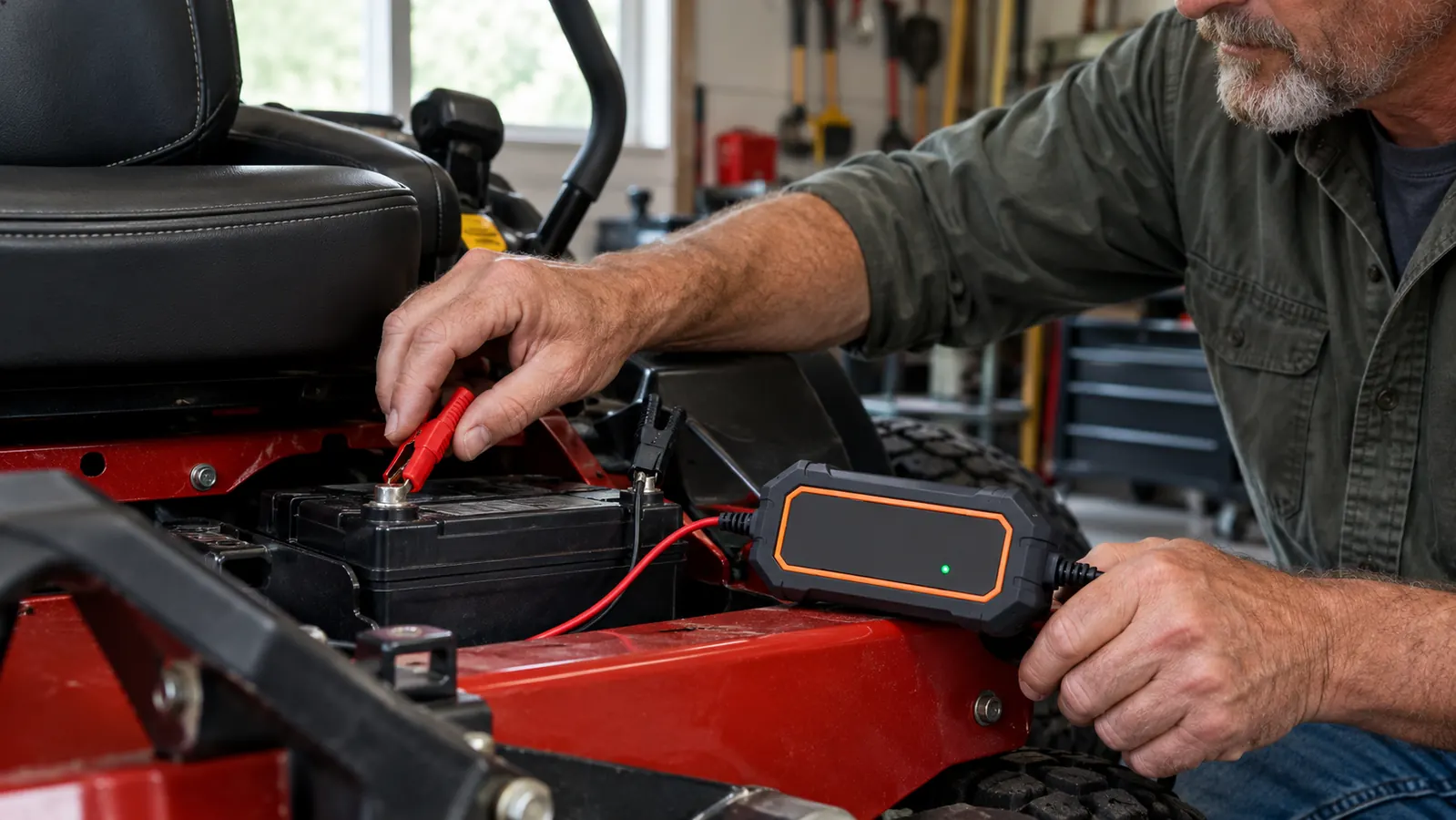
The unit I have is the 750 milliamp version, the one most people mean when they say Battery Tender Junior. It is a small unit with two ring terminals that I bolted to the battery posts, plus a set of alligator clips for when I use it on something else. The battery on my 54 inch zero turn is a standard 12 volt group size, nothing special, the kind that is perfectly happy to die quietly over the winter if you ignore it. The indicator light tells you what it is doing: solid green means the battery is full and it is holding it there, flashing green means it is charging, and red means there is a problem with the connection or the battery.
The important thing to understand is that this is a maintainer, not a jump box and not a full charger. It puts out 750 milliamps, which is a fraction of what a real charger puts out. That is by design. It is meant to sit on a battery for months and replace the tiny amount of charge the battery loses on its own. If you connect it to a battery that is completely dead, it will eventually bring it back, but it can take days. I have done it, and I have also told plenty of customers to save themselves the wait and use a real charger first.
The morning that sold me on this thing was a Tuesday in early March. The overnight low had been 31 degrees. I walked into the garage, saw the solid green light, turned the key on my 54 inch zero turn, and the engine fired before I finished the turn. My neighbor's mower, same age and same battery size, had sat in his shed since October without a maintainer. He needed a jump start that week, and he bought a new battery by the weekend.
What Nobody Tells You About the Battery Tender Junior
The first thing nobody tells you is that the included hardware is not great. The ring terminals work fine, but the alligator clips are thin and the connection feels cheap. I replaced the clips on mine in the winter of 2024 after the spring tension got weak and the wire crimp worked loose. The unit itself has been fine. The accessories are where the corners got cut.
The second thing is the cord. It is long enough to reach from the battery on my mower to the outlet on the garage wall, but just barely. The battery sits under the hood on the right side, and from the battery post to the outlet above my workbench is about six feet. I have to route the cord around the hood latch so it does not pinch. If your mower sits in the middle of a shed with no outlet nearby, you will need an extension cord. That is not a dealbreaker, but it is the kind of detail that only shows up after you are kneeling on the concrete with the clips in your hand.
The third thing is the one that surprises the most customers. The Battery Tender Junior will not revive a battery that has been sitting dead for months. I have had people bring in a battery that read zero volts on my meter, hook this up, and expect it to come back overnight. It will not. Sulfation has already started, and a 750 milliamp maintainer is not the tool for that job. If your battery is truly dead, charge it with a real charger first, then put the Battery Tender Junior on it to keep it that way.
Another thing nobody tells you: the unit gets warm when it is charging. Not hot, but noticeably warm to the touch. That is normal. A customer called me once, worried it was going to catch fire. It is just the transformer doing its job, and the warmth stops once the light goes solid green.
The fourth thing is simpler than you would think: you need an outlet where the mower sits. I have had customers park their mower in a shed with no power at all, and no maintainer in the world helps there. If that is your setup, the Battery Tender Junior is not going to solve your problem.
The Battery Tender Junior will not revive a battery that has been sitting dead for months. That is the part the box does not tell you.
What It Does Well
What the Battery Tender Junior does, it does very well. It maintains. I have left mine connected for four months straight, and the battery on my 54 inch zero turn cranks the engine on the first try every spring. On New Year's Day I checked it with my multimeter and it read 12.8 volts, right where a fully charged battery should sit, after six weeks on the maintainer. The float mode is the whole point. It charges the battery to full, then drops to a maintenance voltage that keeps it there without cooking it. A plain trickle charger does not do that. It just keeps pushing current, and if you leave it on too long, you boil the electrolyte out of the battery.
The automatic shutoff is the feature that earns the price. You connect it, plug it in, and forget about it until spring. There is no timer to set and no risk of overcharging if you leave it on for three months instead of two. I have tested this on my own equipment and on customer batteries that I was storing over the winter. Last year I had four mowers in the back row with Battery Tender Juniors on them. All four started in the spring, and I sold exactly zero batteries to those customers. I cannot say that about every charger that has come through the shop.
It is also genuinely small. It takes up almost no space on the workbench, and it is light enough to toss in a drawer when you are not using it. If you have more than one machine, you can move it between them, though I will say that the more machines you have, the more you will want one per machine, because the whole point is that it stays connected.
One battery I saved was a customer's, left with the key on over a long weekend. It read 11.6 volts when I checked it, low but not dead. I put the Junior on it and it took about two days to climb back to full. That customer used that same battery for two more seasons before it finally gave up.
Where It Falls Short
The biggest shortcoming is the one I already mentioned: it is slow. If you are hoping to use it to charge a battery that is low, you will be disappointed. A 750 milliamp maintainer is not a charger. I have seen customers buy this thinking it will replace their charger, and it will not. A customer brought in a battery last February that measured 10.9 volts on my meter. I told him the honest answer: put it on a real charger for a few hours, then let the Junior take over. He hooked the Junior up anyway and called me a week later asking why the light was still red. It is a different tool for a different job.
The second shortcoming is the accessories. The alligator clips are the weak point, and the ring terminals, while they work, are not the easiest thing to get onto a battery post that is buried under a plastic cover. On my mower, the hood has a lip that rests right over the battery tray, so I routed the leads along the frame and under the hood latch bracket with a zip tie. It took about ten minutes of fiddling, and it is the kind of thing that is easier to do once and leave connected than to do every time.
The third shortcoming is that there is no way to know the battery's actual state of charge. The indicator light tells you whether it is charging, full, or faulted, but it does not tell you the voltage. For a maintainer, that is acceptable. For a diagnostic tool, it is not. The red light also does not tell you whether the problem is the battery or the connection. I have watched customers swap a perfectly good battery because they assumed red meant dead. Check your connections first, and keep a multimeter handy.
What I Liked
- Keeps a battery topped off all winter with no babysitting
- Automatic shutoff means no overcharging risk if you leave it connected
- Small and easy to store in a drawer
- Ring terminals can stay bolted to the battery so hookup takes seconds
- Proven track record through several winters on my own mower
Where It Falls Short
- 750 milliamp output is slow, not a real charger for a dead battery
- Included alligator clips feel cheap and the spring tension goes soft
- No voltage readout, just three indicator lights
- Cord is only just long enough for a typical garage setup

How It Compares to a Trickle Charger
Customers ask me all the time whether they can just use a cheap trickle charger instead. The honest answer is that a trickle charger will keep a battery from going dead, but it will not do it as safely. A trickle charger pushes a constant low current, and if you forget about it, it can overcharge the battery and shorten its life. The Battery Tender Junior monitors the voltage and shuts off when the battery is full. That difference matters when the charger is going to sit connected for four months. I have seen batteries come through the shop with the tops bulged from a trickle charger left on too long, and I have never seen that from a Battery Tender Junior.
I have also had customers ask whether they need the more expensive version with the higher output. For a zero turn mower battery, the answer is usually no. The Junior is enough. The bigger units are for larger batteries or for people who want to charge faster. If you are maintaining a mower battery over the winter, the Junior is the right size and the right price point. Spend the difference on a good multimeter.
The other difference is the price gap. A cheap trickle charger costs a little less, but it lacks the automatic shutoff. Over the life of a battery, that difference is a few dollars and a lot of peace of mind. I would rather sell a customer one Battery Tender Junior than sell them a new battery every other year.
Who This Is For
The Battery Tender Junior is for anyone who parks a machine for more than a couple of weeks and wants it to start when they come back. That includes the guy with a 54 inch zero turn on two and a half acres, the guy with an ATV that sits in the shed, and the guy with a classic car that only comes out on weekends. If you have ever walked out to the garage in the spring, turned the key, and heard nothing but a click, this is the tool that prevents that exact moment. It is also for the person who is tired of buying a new battery every other year. A maintainer will not make a battery last forever, but it will keep a good battery good.
Who Should Skip It
Skip it if you are looking for a charger to bring a dead battery back to life. That is not this tool's job, and you will be frustrated if you expect it to be. Skip it if you have a battery that is already sulfated or swollen, because no maintainer is going to fix that. And skip it if you are the kind of person who starts the mower every couple of weeks in the winter and lets it run for ten minutes. That routine is hard on an engine, but it does keep the battery charged, so a maintainer is not strictly necessary. And if you already own a smart charger with a float mode, you do not need this. It would be a duplicate.
The honest bottom line
The Battery Tender Junior is not a charger and it is not a cure-all. It is a maintainer that does exactly one job, and it does that job well. If you want your zero turn to crank in the spring, this is the tool I put on my own mower. Check today's price on Amazon and read the reviews for yourself. The rating reflects what it actually is: a simple, reliable maintainer.
Amazon Check Today's Price on Amazon →