
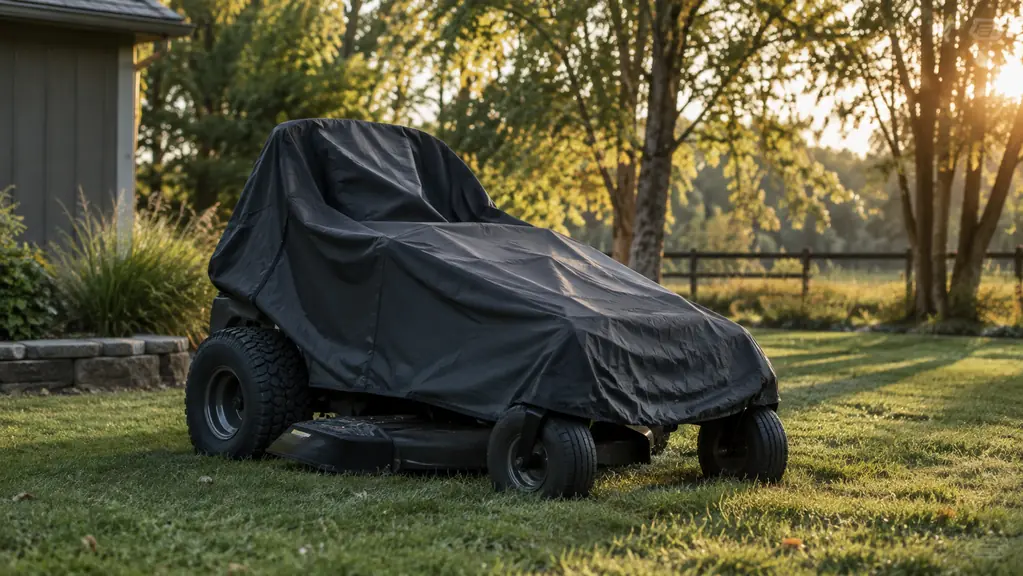
I spend my workdays in the service bay at a small-town outdoor power equipment dealership in East Texas, and I have lost count of how many zero turns I have seen come in with a wiring harness chewed by a mouse, a seat that cracked after one summer of full sun, or a deck that looked like it had been dragged through a gravel pit. Most of that damage did not happen while the mower was running. It happened while the mower sat. So when I decided to stop leaving my own 54 inch zero turn out in the weather, I picked the Tough Cover zero turn mower cover and ran it for a full year outside. This is what that year looked like.
The Quick Verdict
After 12 months of East Texas sun, rain, and oak pollen, the Tough Cover zero turn mower cover kept my 54 inch deck dry, kept the seat from cracking, and still fits snug. It is not a garage, but it is the next best thing for a mower that has to live outside.
Amazon Check Today's Price →Keep your zero turn out of the weather for less than a tank of gas
The Tough Cover zero turn mower cover fits decks up to 60 inches, cinches down against wind, and has now spent a full year on my own mower. Check today's price on Amazon and see if it fits your deck.
Amazon Check Today's Price on Amazon →How I've Used It
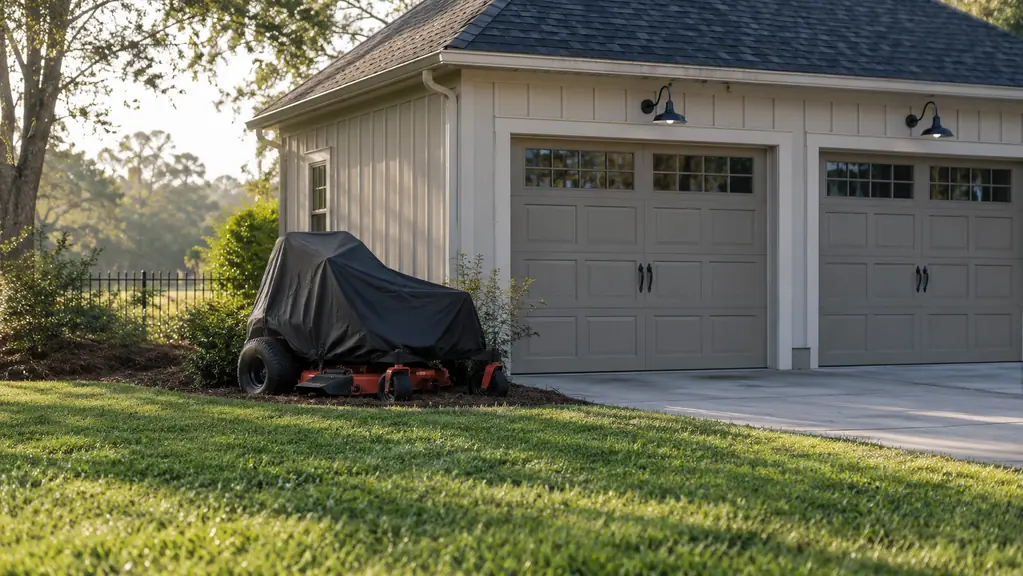
My setup is simple. I have a detached two-bay garage at home with a workbench, a floor jack, and a bench grinder, but the garage is full of tools and projects, so my mower lives outside on the north side of the shop. That is exactly the situation this cover is made for. I put it on in early March of last year and took it off for the first time in late February, so it saw all four seasons, including a stretch of 100 degree days and a few hard freezes.
The mower is my own 54 inch zero turn, and I mow about two and a half acres of St. Augustine and Bermuda with it. That means the cover went on and off at least once a week, sometimes twice, all year. I did not treat it gently. I pulled it on by the corners, let it flap in wind, and left it on through a couple of thunderstorms. If a cover is going to fail, that routine should have found it.
For this test, I moved my mower out of the garage bay and parked it under the eave on the gravel pad beside the garage for most of the year, because I needed the bay for a project. That spot gets full afternoon sun in summer, blowing rain off the field in spring and fall, and dew most mornings. It is about as hard on a mower as a residential setup gets in East Texas, and it is where I see the most cover failures on customer mowers. If a cover was going to fade, leak, tear at the straps or blow off in a storm, that pad would show it. Most of my customers who store a mower outside have a spot just like it.
One thing I did from day one: I let the engine and the deck cool down before I put the cover on. Hot metal against a cover is how you get melted fabric and a smell that never quite goes away. That is not a Tough Cover problem, that is a physics problem, and it applies to every cover on the market.
What the Tough Cover Is Made Of
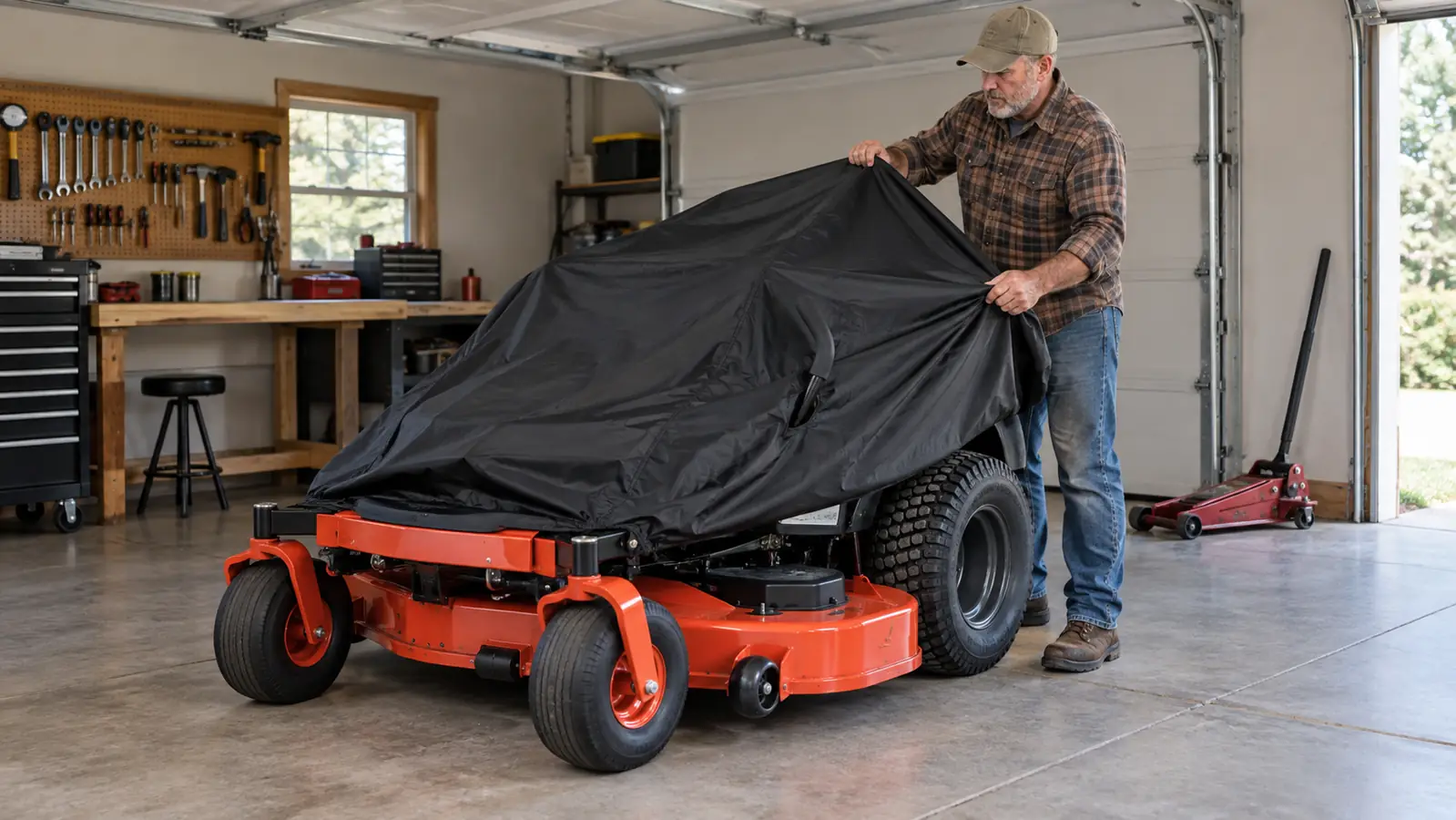
The Tough Cover zero turn mower cover is made from a 600D polyester fabric with a water resistant coating. For anyone who has not spent time around outdoor fabrics, 600D is the same general weight class as a lot of decent trailer covers and heavy duty grill covers. It is not a flimsy tarp, and it is not a canvas tarp either. It sits somewhere in the middle, and for a mower that sits outside, that is about the right place.
The seams are stitched and then taped, which is the detail I check first on any cover. A cover can have the best fabric in the world, but if the needle holes along the seams are not sealed, water will find them. After a year of rain, my Tough Cover has not leaked through a single seam. The water beads up and runs off the top, and the underside stays dry.
I also looked at the inside of the hem, where cheaper covers fray first. The Tough Cover hem is double stitched with the elastic cord sewn into a channel, so the cord pulls the fabric evenly instead of bunching it in one spot. After a year, the channel stitching is still tight and the cord still snaps back when you stretch it. On cheaper covers I have seen the cord pull out of the hem in the first season, and once that happens the cover flaps in every wind and wears through where it rubs the seat back and the roll bar.
The bottom edge has an elastic cord with a cinch, and there are straps that go under the mower. That matters more than most people realize. A cover that fits like a loose tarp will act like a sail in a thunderstorm, and a sail is exactly what you do not want wrapped around your mower at 2 AM. The cinch on the Tough Cover pulls it down tight enough that I have never had it blow off, even on the windy days we get in March.
How It Held Up Over a Year
The honest headline is that the Tough Cover zero turn mower cover survived a year outside and still looks like it has plenty of life left. The fabric has not faded badly, the seams have not split, and the elastic is still doing its job. I expected the sun to be the thing that killed it, because East Texas sun is hard on everything. The cover has some color change, but nothing that affects how it works.
The color held up better than I expected for a cover in full Texas sun. The top panel, which gets the most sun, has faded slightly compared to the sides, but there is no chalkiness and no cracking in the coating. I ran the same check I run on customer covers: pour a cup of water on the top panel and watch whether it beads or soaks. After a year it still beaded and ran off. When a coating breaks down, you see the water spread out and darken the fabric, and the cover starts holding moisture against the mower instead of keeping it off. That had not happened by the end of my test.
The part that surprised me was the seat. Before I started using the cover, the seat on my mower was starting to show the usual cracking on the side that faces the afternoon sun. After a year under the Tough Cover, the cracking has not gotten worse. That alone is worth the price of the cover, because a replacement seat for a zero turn is not cheap, and the labor to put it on is not free either.
I also checked the wiring harness and the ignition switch area when I pulled the cover off in the spring. No mouse nests, no chewed wires. I cannot promise the cover is the reason, because a mouse can get into anything, but a cover does remove the easy invitation. A dry, dark, sheltered spot under a cover is still a spot a mouse might like, so I keep a couple of traps near the mower. The cover is not a pest control product, and I do not want to oversell it.
That matters more than most owners think. At the shop, the outdoor mowers that come in with no start problems in spring often have corroded connectors at the ignition switch or the seat safety switch, because water got into them over the winter. Those are small parts, but tracing an intermittent connection takes shop time, and shop time is the expensive part of any repair. A cover that keeps rain and dew off the dash and the seat is preventing exactly that kind of job. On my own mower, every connector I checked at the end of the year was clean and dry.
After a year outside, the seat on my mower has not cracked any further, the wiring harness is clean, and the cover still fits snug. That is the whole job, done.
The Downsides Nobody Mentions
There are a few things I would want you to know before you buy. First, the cover is not completely waterproof in a biblical downpour. It is water resistant, and it will shed a normal rain, but if you get a storm with wind driven rain coming at an angle, you can find damp spots on the seat or the deck. That is true of almost every cover in this price range, and I would rather tell you that now than have you discover it after a storm.
Second, the cover holds heat. If you put it on a mower that is still warm, you are basically wrapping the mower in a blanket, and that is not good for the battery or the plastic parts. I always let the mower cool down first, and I would recommend you do the same. It takes ten minutes, and it costs nothing.
Third, the fit is snug, which is mostly a good thing, but it means you need to line up the front of the cover with the front of the mower. If you put it on backwards, it will still cover most of the machine, but it will not cinch down the way it should. I put a small mark on the cover and a matching mark on the mower with a paint pen, and now I never have to think about it.
Fourth, a cover is only as good as how you put it on. Pull it over the roll bar first, then down over the seat and the engine, then tighten the straps under the deck and cinch the hem. If you leave the straps loose, wind gets under the cover and works it back and forth across the seat and roll bar, and that is how even a good cover wears through. It takes me about two minutes to cover and uncover the mower, and after a few weeks it becomes habit. That two minutes is what keeps the cover lasting more than one season.
Who This Is For
The Tough Cover zero turn mower cover is for anyone whose mower has to live outside, under a carport, or in a shed that is not fully sealed. If you have a garage bay that is actually empty, you do not need this cover, and I would tell you to save your money. But if your mower sits out in the weather like mine does, this cover will pay for itself the first time it keeps a wiring harness dry or stops a seat from cracking.
It is also a good choice if your mower lives in an open shed, a carport or a barn where birds roost and dust settles. Bird droppings are acidic and will eat into paint and seat vinyl, and barn dust mixed with humidity turns into a film that holds moisture against the metal. A cover keeps all of that off and means the mower is clean when you pull the cover off on mowing day. The Tough Cover fits decks up to 60 inches, so it covers most residential zero turns, but measure your deck and the height of your roll bar before ordering so you know it will reach the ground on your machine.
Who Should Skip It
Skip the Tough Cover if your mower lives in a fully enclosed, dry building. A cover is a compromise, and if you do not need the compromise, do not buy it. I would also tell someone with a deck larger than 60 inches to measure carefully, because this cover is sized for decks up to 60 inches, and a bigger deck needs a bigger cover. And if you are the kind of person who will not wait for the engine to cool down, this cover will not survive you. Neither will any other cover.
What I Liked
- 600D fabric still beads water after a year in sun and rain
- Taped seams kept the seat and dash dry through storms
- Elastic hem and under-deck straps held it on in wind
- Fits decks up to 60 inches, comfortable on a 54 inch zero turn
- Kept ignition and seat switch connectors clean and dry
Where It Falls Short
- Top panel fades slightly in full sun
- Snug fit means you have to pull it over the roll bar first
- Should not go on a hot engine and muffler right after mowing
A year outside and still going strong
The Tough Cover zero turn mower cover has earned its spot on my mower. If yours sits out in the weather, check today's price on Amazon and see if it fits your deck.
Amazon Check Today's Price on Amazon →