
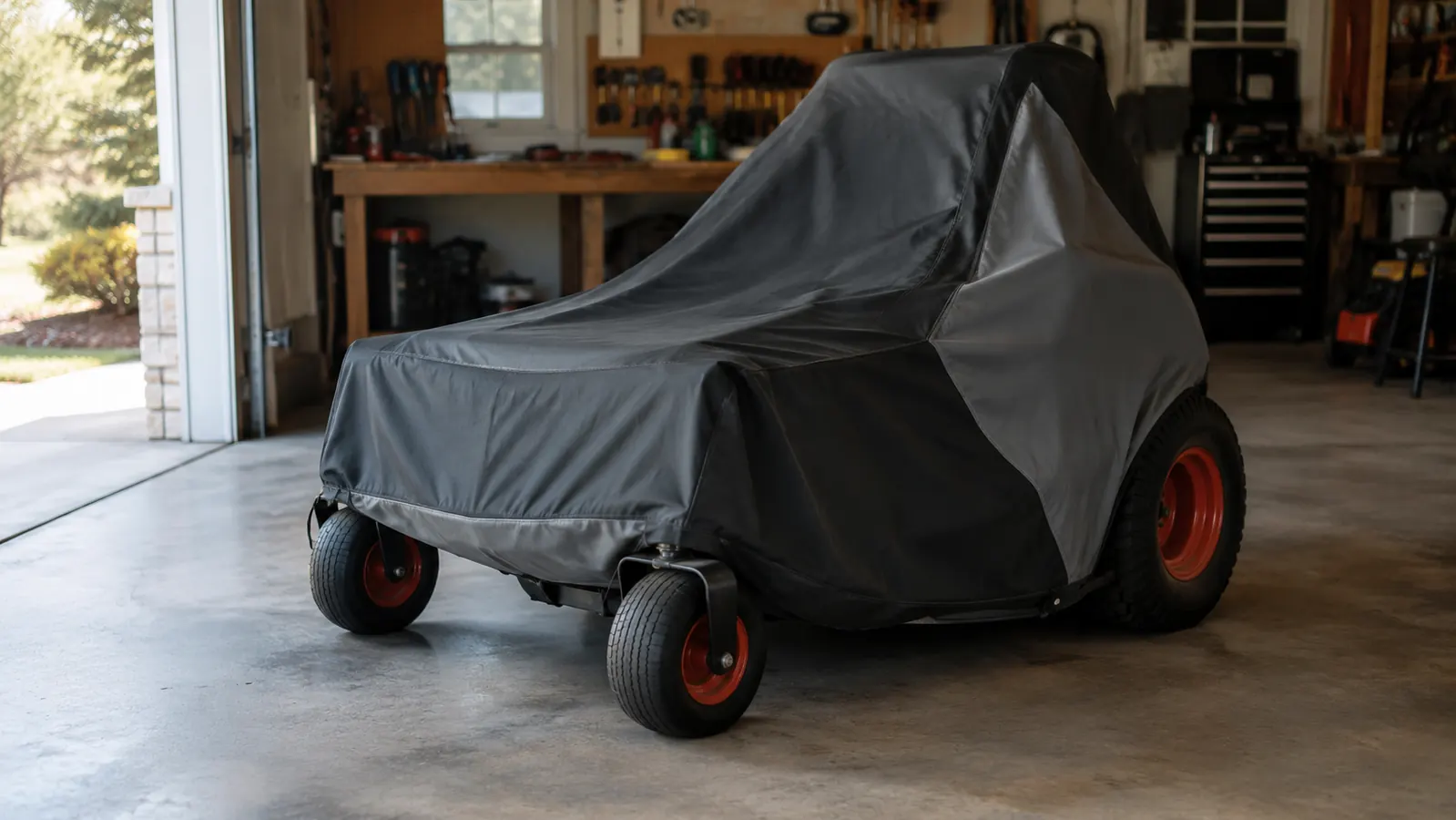
I've spent over twenty years on the bench at a small-town outdoor power equipment dealership in East Texas, and I've seen what a season of weather does to a zero turn that never gets covered. I've also seen what customers tell themselves instead of buying a cover: it's in the garage, it's under the carport, it's only a little dew. So when I finally bought a Tough Cover for my own 54 inch zero turn, I went in with a skeptic's eye and a service tech's habit of checking the seams, the straps, and the way the wind treats it. This is the honest review I'd give you across the counter, not the one on the box.
The short version: the Tough Cover is the cover I'd put on my own mower again, and I've already done that once. But it is not a perfect cover, and there are a few things nobody tells you before you buy one. I'll get to those, because they matter more than the star rating.
The Quick Verdict
A well-made fitted cover that earns its spot if you park outside or in a dusty shop. It is not fully waterproof forever, and the straps need a little attention in high wind. For the money, it's the first cover I'd hand a customer.
Amazon Check Today's Price →The cover I put on my own 54 inch zero turn
After a full season of Texas sun, thunderstorms, and shop dust, the Tough Cover is the one I'd buy again. Check today's price on Amazon and see if it fits your deck.
Amazon Check Today's Price on Amazon →How I've Used It
My mower at home is a residential zero turn with a 54 inch deck, and it lives in a detached two-bay garage with a workbench, a floor jack, and a bench grinder. That sounds like the ideal setup, and it is, except for one thing: the garage is also where I sharpen blades, drain oil, and grind down the occasional bent spindle. That means fine metal dust and oil mist settle on everything, including the mower. The Tough Cover's real job at my place is keeping the mower clean between uses, and it does that better than any tarp I've used.
I want to explain how I judge a mower cover, because it is different from how a product listing does it. At the shop, I see covers at the end of their life. They come in still on the mower, faded white on top, torn where the roll bar rubs through, with the elastic hanging out of the hem and a buckle missing. I also see what was under them: a cracked seat, a rusty deck shell where water pooled, and corroded connectors. So when I tested the Tough Cover on my own mower, I was looking for those failure points in particular, not for how it looks the day you open the box.
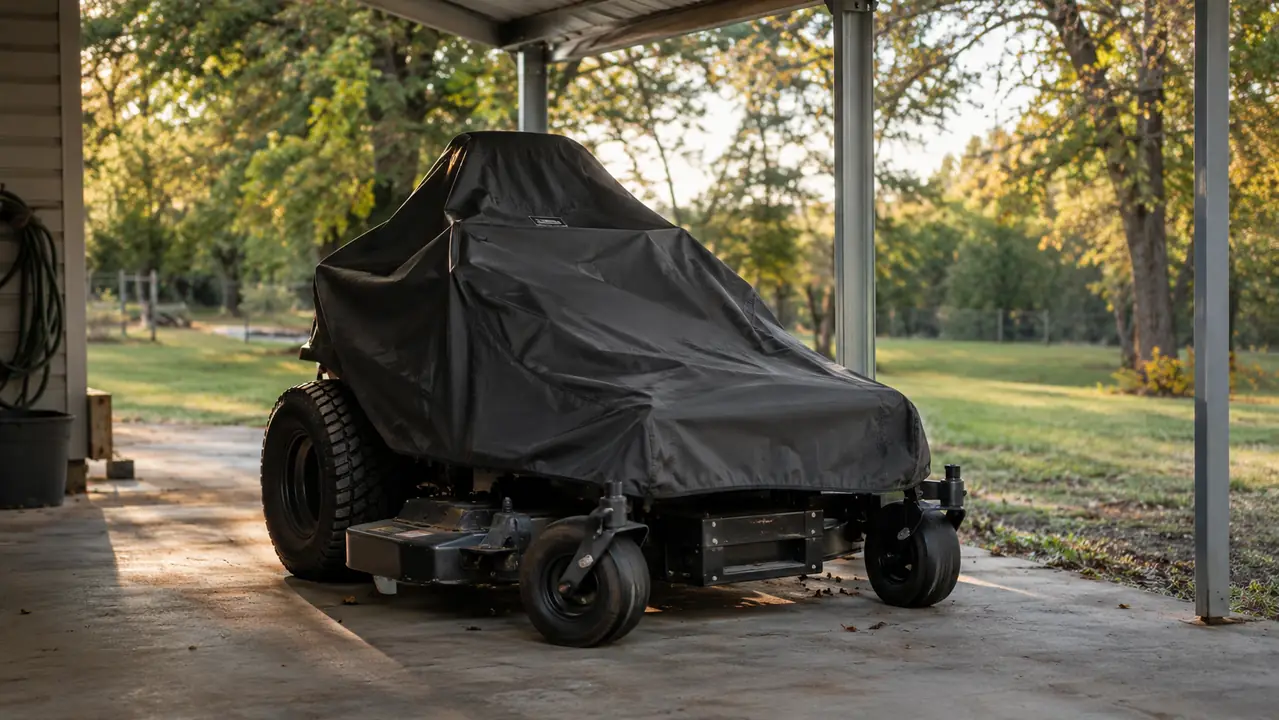
I also ran it outside for a stretch to see what it would do in real weather. East Texas gave me a fair test: a couple of gully-washer thunderstorms, one hailstorm that stayed small, and weeks of 95 degree sun. The cover stayed put through all of it. The fabric beaded water the way a good 600D cover should, and the seams never opened up.
That outdoor stretch covered about four months from late spring into summer on the gravel pad beside my garage. In that time we had several heavy thunderstorms with wind that bent the tomato cages in the garden, plenty of mornings with heavy dew, and the kind of afternoon sun that makes a dark mower seat too hot to touch. After each storm I pulled the cover back and checked the seat, the dash and the top of the engine for water. Each time they were dry. The one place I found moisture was a small damp spot on the deck where water ran down the outside of the cover and wicked under the hem, which is normal and dried within the morning.
One thing I'll tell you straight: I did not leave it on through a hurricane, and I would not expect any fabric cover to survive a direct hit from a tree limb. A cover is for weather, dust, and UV. It is not a shed.
What Nobody Tells You Before You Buy
Here's the part I wish someone had told me when I was standing in the aisle trying to decide. The Tough Cover is not a single piece of magic fabric. It is a well-made cover with real limitations, and knowing them before you buy saves you from being disappointed later.
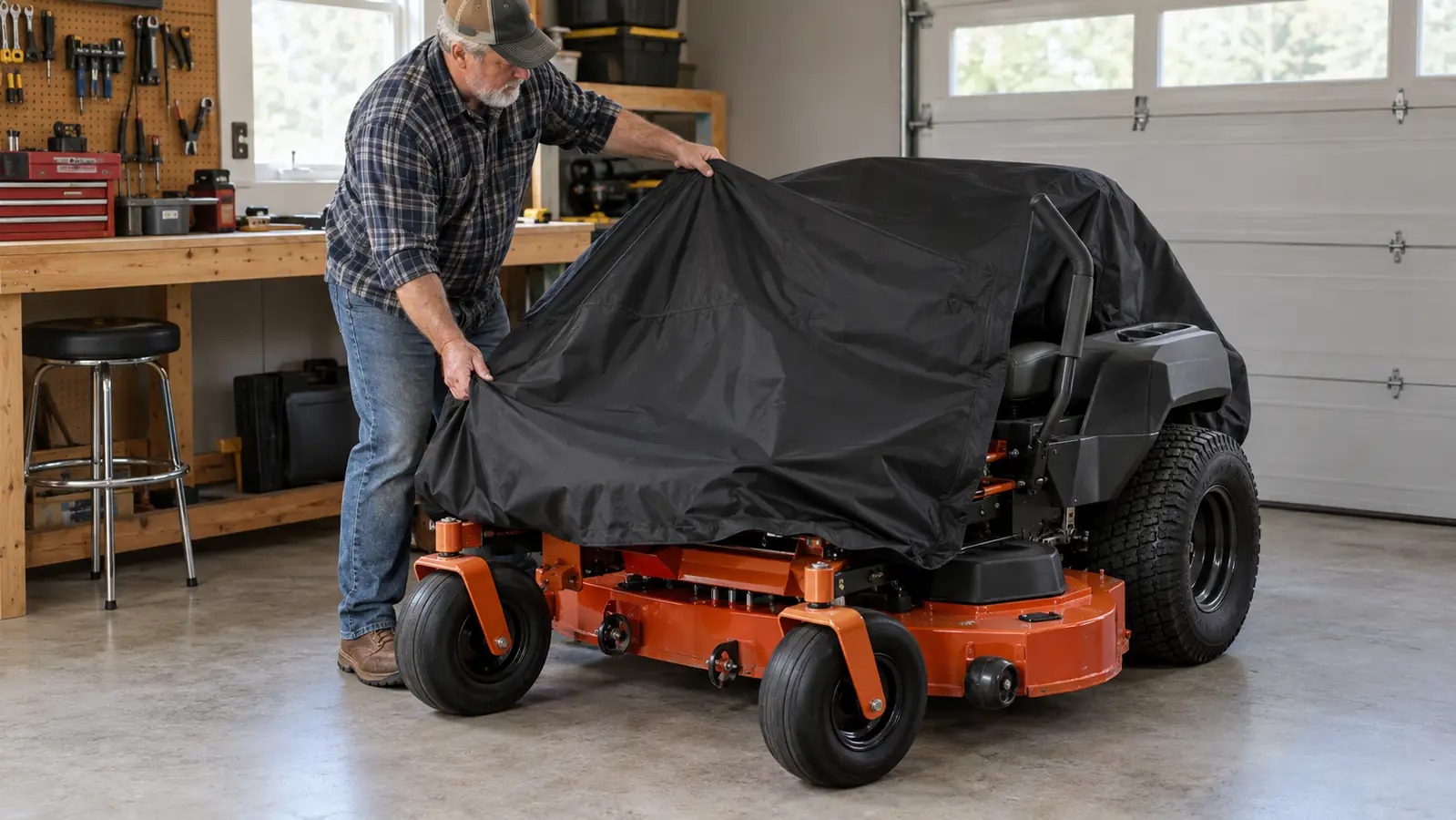
First, the fit is snug on purpose. That's a good thing for wind, but it means you need to line up the front and back markers the first few times. If you just throw it on like a tarp, you'll fight the seams and the straps will sit crooked. Once you learn the two-minute routine, it goes on easy. Until then, expect to cuss it once or twice.
Second, the buckles and straps are the part most likely to wear out, not the fabric. I've seen it on other covers and I've seen it on this one. The straps on mine are still in good shape after a season, but I check them the same way I check a customer's tie-downs: give them a tug, look for fraying, and replace them before they fail, not after.
I checked mine at the end of the season by pulling hard on each strap at the stitching and working each buckle a dozen times. Nothing pulled loose and the buckles still latched firmly. If one does fail down the road, a replacement buckle from a hardware store fixes it, and a cover with a broken buckle should be fixed rather than thrown away. The fabric is the expensive part, and on mine the fabric still had a lot of life left.
Third, and this is the one that surprises people: a cover that stays on full time in a humid climate can trap moisture underneath. If you park a hot mower and throw the cover on immediately, you're asking for condensation. Let the engine and deck cool for a few minutes first. That's not a Tough Cover problem, that's a physics problem, but it's the kind of thing nobody puts on the box.
The fix is simple and it is what I do on my own mower. On a dry, sunny day, pull the cover off for a few hours and let the mower and the inside of the cover air out, especially after a stretch of rain or humid weather. Never put the cover on a wet mower; let it dry first. And give the engine and muffler time to cool before you cover the machine, because a hot muffler can damage the fabric and the trapped heat adds to condensation. Treat the cover like a raincoat, not a sealed bag, and it will protect the mower instead of trapping moisture against it.
The fabric beaded water the way a good 600D cover should, and the seams never opened up through a full season of Texas thunderstorms.
Build Quality and Materials
The Tough Cover is made from 600D polyester, which is the same weight class I recommend to customers who park outside. It's thicker than the cheap 300D covers you'll find at the big box store, and you can feel the difference when you pick it up. The stitching is double-stitched on the high-stress seams, and the hem is reinforced where the straps attach. That's where cheap covers fail first, and the Tough Cover is built like someone knew that.
The underside is a soft lining, which matters more than most people think. A cover with a rough underside will rub the paint off your fenders in a windstorm. I've seen that exact complaint come through the shop on other brands. The Tough Cover's lining is soft enough that I don't worry about it scratching the deck or the fenders.
The lining also keeps grit from grinding against the plastic. Every time the wind moves a cover, anything trapped between the fabric and the mower acts like sandpaper. On a cover with a rough inside, I have seen a dull scuffed patch worn into a dash panel and the top of a fuel tank after one season. On my mower, the dash and the fuel tank cap area looked the same at the end of the season as they did at the start. It is the kind of detail you never think about in the store and appreciate a year later.
The seams are taped on the inside, which is a detail I look for because it's the difference between a cover that leaks through the needle holes and one that doesn't. After a season of thunderstorms, the underside of mine stayed dry. That's the test that matters.
The roll bar area is where I looked hardest, because that is where water and wear meet. On most covers, the fabric stretched over the top of the roll bar is the first place to leak and the first place to wear through. On mine, the seam that runs near that spot stayed sealed through every storm, and the fabric over the bar showed no thinning at the end of the season.
How It Holds Up Over Time
I've had mine for a full mowing season, which in East Texas means about eight months of real use. The fabric has faded a little in the sun, which is normal and cosmetic. The important parts, the seams, the straps, the buckles, are all still doing their job. I've seen cheaper covers turn brittle and start flaking after one summer. This one still flexes like new.
Over that season the top panel faded a little in the sun, which every fabric cover does, but it did not chalk or crack, and water still beaded on it at the end of my test. The stitching around the roll bar area, where covers usually tear first, was still tight. I would expect to get several seasons out of it on a mower parked outside in East Texas, and more than that on a mower parked under a carport or in an open shed where it is out of the direct sun most of the day.
The elastic cord around the bottom edge is another detail that holds up. On cheap covers, that elastic goes slack within a season and the cover starts ballooning in the wind. Mine still snaps tight against the deck. That's the difference between a cover that stays put and one that ends up in the neighbor's yard.
I'll also say this: the Tough Cover has saved me real time at the shop. A covered mower doesn't collect dust and pollen in the same way, so I'm not blowing it off before every ride. And when I do maintenance, I'm not wiping grime off every fitting before I can get a wrench on it. That's the kind of benefit that doesn't show up in the photos but shows up every time you work on the machine.
Who This Is For
Buy the Tough Cover if you park your zero turn outside, under a carport, or in a shop that isn't climate controlled. Buy it if you're tired of wiping dew, dust, and bird droppings off the seat before every mow. Buy it if you want your mower to look as good in year five as it did in year one. If you're the kind of owner who changes oil on schedule and sharpens blades in the spring, this cover fits the way you already take care of your equipment.
Measure before you order. The Tough Cover fits decks up to 60 inches, so it covers most residential zero turns comfortably, but a machine with a tall roll bar or a large rear bagger may need a bigger cover. Measure the deck width, the length from the front casters to the back of the engine, and the height to the top of the roll bar, and compare those to the listing. A cover that is too small will not reach the ground and will catch the wind. One that fits properly will sit snug and stay put through the kind of storms that blow through East Texas every spring.
Who Should Skip It
Skip it if your mower lives in a sealed, climate-controlled garage and never sees sun, dust, or moisture. In that case, a cover is solving a problem you don't have. Skip it if you're looking for a fully waterproof cover that can sit through weeks of rain without a thought. The Tough Cover is water-resistant and it handles a normal storm fine, but no fabric cover is a swimming pool. And skip it if you're the kind of person who won't take two minutes to put it on right. A cover you throw on crooked is a cover that flaps in the wind and wears out early.
What I Liked
- 600D fabric kept the seat and dash dry through several heavy storms
- Taped seams with no leaks at the roll bar area
- Soft lining kept grit from scuffing the dash and fuel tank area
- Straps and buckles held up to a full season of use
- Fits decks up to 60 inches
Where It Falls Short
- Top panel fades slightly in full sun
- Needs to come off on dry days to air out after wet weather
- Snug fit takes a minute to learn over the roll bar
Still on the fence?
I've recommended the Tough Cover to customers who park outside and to customers who just want their mower to stay clean in the shop. It's the cover I kept. Check today's price on Amazon.
Amazon Check Today's Price on Amazon →