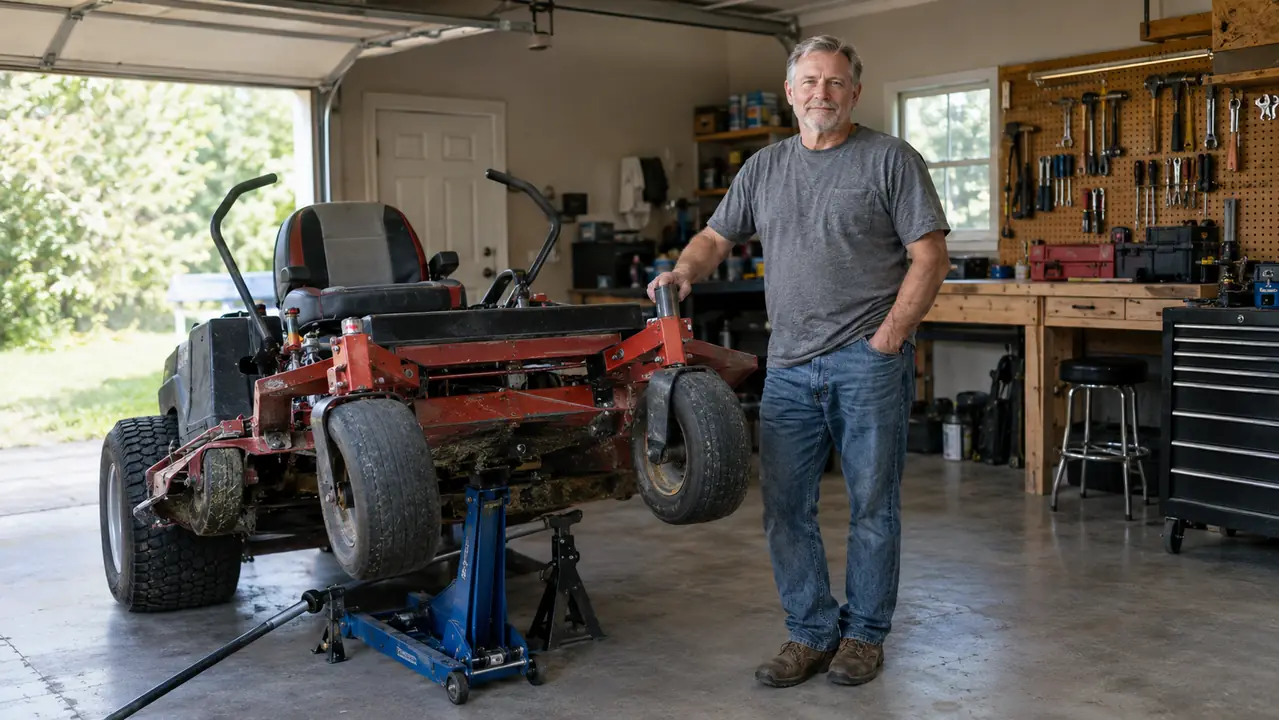
I spent 20 years on the bench at a small-town outdoor power equipment dealership in East Texas, and for most of that time I told customers the same thing about lifting a zero turn: put a block under the frame, or tip it up against a wall, and you can get to the blades well enough. I meant it, too. Then I started using one at the dealership, bought a MoJack EZ MAX for my own garage, ran it for two seasons on my own 54 inch zero turn, and I have to tell you I was wrong about how much easier a real lift makes the job.
This is the honest version of that story. Not the product page version, not the unboxing video version. What the MoJack EZ MAX does well, what it does not do well, where it feels like a cheaper tool than it is, and whether you should spend your money on one or keep using the block of wood. I have no reason to oversell it. I just want you to know what you are actually buying before you click the button.
The Quick Verdict
The MoJack EZ MAX is the rare shop tool that makes a miserable job genuinely easier. It is not perfect, the casters are the weak point, and you still have to think about what you are doing. But for anyone who sharpens blades more than once a season, it earns its spot on the garage floor.
Amazon Check Today's Price →Stop flipping your mower on its side to sharpen the blades
The MoJack EZ MAX lifts the front of your zero turn or lawn tractor so the deck is right at working height. No blocks, no tipping, no lying on your back in the grass. Check today's price on Amazon and see if it fits your mower.
Amazon Check Today's Price on Amazon →How I've Used It
My own mower is a residential zero turn with a 54 inch deck, and I keep it on about two and a half acres of St. Augustine and Bermuda. That means I am under that deck more often than I would like. Blades get dull fast in sandy East Texas soil, and a dull blade tears the grass instead of cutting it. By midsummer I was pulling the deck off or tipping the mower at least every three or four weeks.
I ran the MoJack EZ MAX through two full seasons of that routine. Blade changes, deck cleaning, belt inspection, spindle checks, even a couple of grease fittings I had been ignoring because they were hard to reach. The lift stayed in my two-bay garage at home, on the same concrete floor where I keep my workbench, my floor jack, and my bench grinder. It did not live in the box. It sat out, got bumped, got grass clippings and dust on it, and generally got treated the way a shop tool actually gets treated.
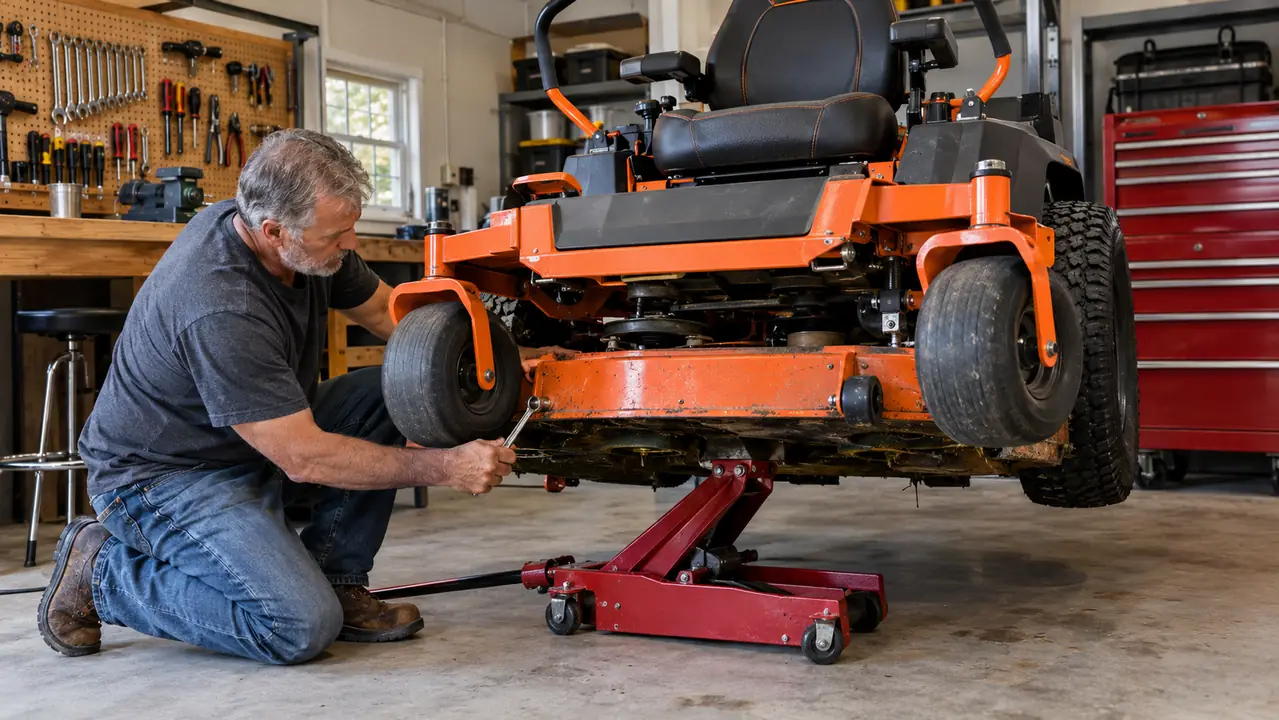
The MoJack EZ MAX is rated for 450 pounds, which covers most residential zero turns and lawn tractors. My 54 inch deck mower is well inside that number, and the lift handled it without straining. The frame is welded steel, the lift mechanism is a screw jack, and the whole thing rolls on small casters. You set the lift arm under the front axle and crank the handle until the front wheels come off the floor.
What Nobody Tells You Before You Buy
The first thing nobody tells you is that the MoJack EZ MAX does not lift the whole mower. It lifts the front. The rear wheels stay on the ground, which means the mower is still taking up the same footprint in your garage, just tilted. That is fine for blades, spindles, and the front of the deck. It is not fine for anything under the rear of the machine, and you should know that before you buy.
The second thing nobody tells you is that the casters are the weak point. They are small, hard plastic wheels, and they do not roll smoothly on rough concrete. On a smooth garage floor they are fine. On cracked or brushed concrete, you will be wrestling the lift a little. I have seen guys at the shop replace the casters with larger rubber ones, and honestly that is a worthwhile upgrade if the small wheels annoy you.
The third thing is the one that matters most: you still have to use your head. The MoJack EZ MAX is a mechanical advantage, not a safety device. You have to get the lift arm in the right spot under the front axle, you have to make sure the mower is centered, and you have to chock the rear wheels or leave the parking brake set. If you do those things, it is stable. If you do not, you can tip a mower off a lift just as easily as you can tip one off a block.
The MoJack EZ MAX is a mechanical advantage, not a safety device. You still have to get the lift arm in the right spot and set the parking brake. Do that, and it is rock solid. Skip it, and you can tip a mower off a lift just as fast as off a block.
What It Does Well
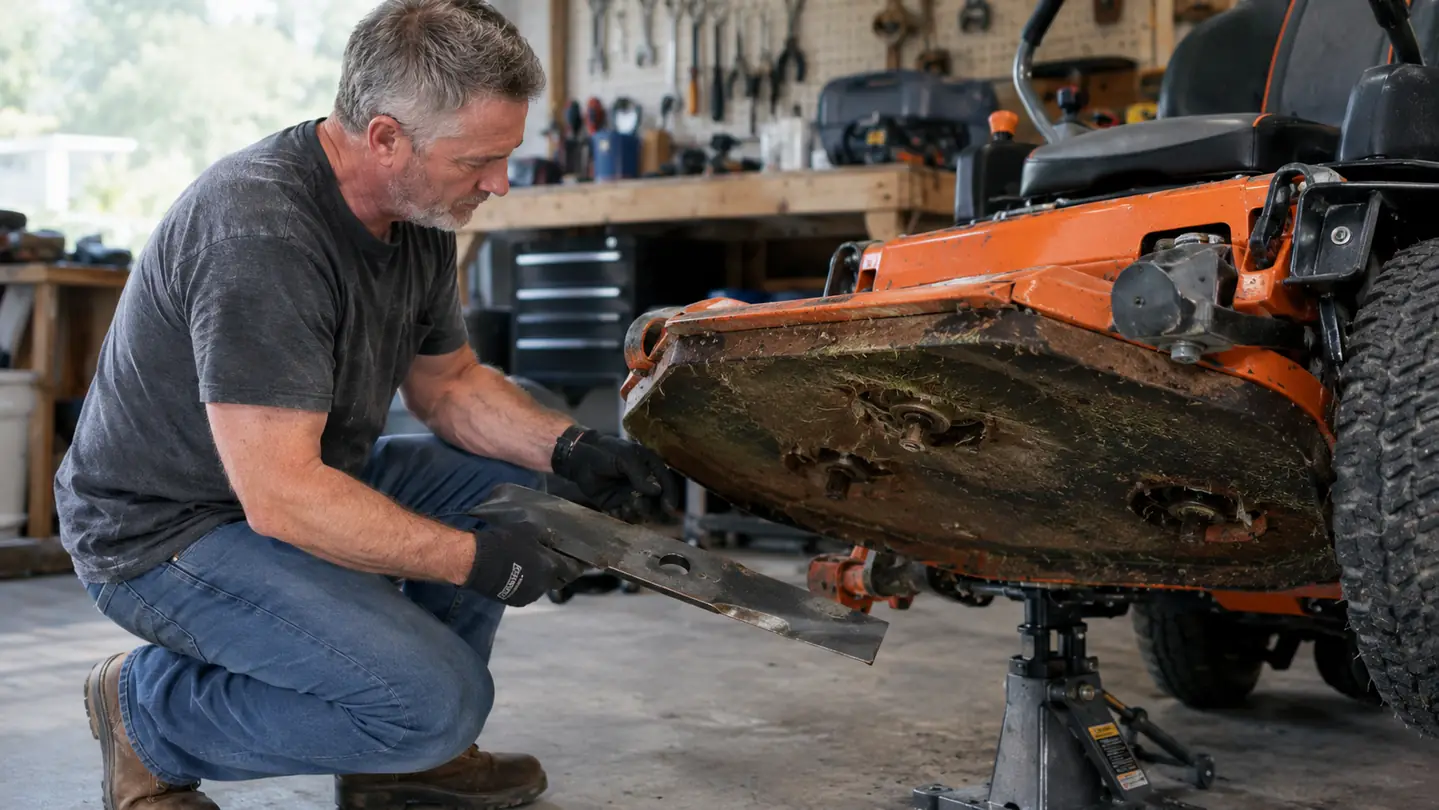
The first time I used the MoJack EZ MAX, I sharpened the blades on my 54 inch zero turn in about twenty minutes, and I did not have to lie on my back in the grass once. That is the whole pitch, and it delivers. The deck comes up to a working height where you can stand or kneel comfortably, the blades are right there, and you can see what you are doing instead of reaching blind.
The screw jack mechanism is simple and it works. A few turns of the handle and the front of the mower comes up smoothly. There is no hydraulic fluid to leak, no seals to fail, no pump to rebuild. If something breaks, it is a mechanical part you can look at and understand. That matters to me, because I am the guy who ends up fixing the complicated stuff when it fails.
It is also faster than the crank makes it look. The handle comes off with one nut and bolt, and underneath is a 3/8 inch square receiver. I put a 3/8 inch driver in my cordless drill, set the clutch low and let the drill raise the mower, and the front of my 54 inch zero turn comes up in well under a minute. A spring pin clicks into a safety hole on the tower as the arm rises, so the mower is locked at each step. The only upkeep the manual asks for is a few drops of light machine oil on the screw threads once a year, and I do that every spring when I first pull the MoJack EZ MAX out from against the garage wall.
It also makes the jobs you put off actually get done. I am not proud of how long I ignored the grease fittings on my spindles, but I ignored them because reaching them meant tipping the mower or pulling the deck. With the MoJack EZ MAX, I can grease the spindles in five minutes. That kind of maintenance is what keeps a zero turn alive past the warranty, and a lift that makes it easy is worth something.
Where It Falls Short
The casters are the first thing I would change. They are small and hard, and they pick up every crack in the concrete. On smooth floor they are fine, but my garage floor is not smooth, and I found myself lifting the front of the MoJack EZ MAX to steer it more than I expected. A set of larger rubber casters fixes it, and I would budget for that if you have rough concrete.
If your garage floor is cracked or sloped like mine, test the casters on it before you count on rolling a loaded lift across the bay.
The second shortfall is that it takes some patience to position. The lift arm has to sit squarely under the front axle with the mower centered, and on my mower I raise the deck to its top cutting height first so the arm slides under without catching. If you are off center, the mower lifts crooked and you have to lower it and start over. It is not dangerous if you check it before you reach under, it just takes patience, and it is the kind of thing you only learn by doing it.
The third shortfall is the one I keep coming back to: it only lifts the front. If you need to service the rear of the mower, the transmission, the pulleys at the back of the deck, or the rear tires, the MoJack EZ MAX does not help you. You are back to blocks or a floor jack. That is not a flaw in the design, it is the design, but it is the thing nobody tells you in the reviews.
How It Compares to the Alternatives
The cheapest alternative is the block of wood I used for years. It works, it costs nothing, and it is fine for a quick blade change. But it does not give you working height, it does not roll, and it is only as stable as the surface you put it on. The MoJack EZ MAX is better in every way that matters, and the only reason to stick with a block is if you sharpen blades once a year and never do anything else under the deck.
The other alternative is a full mower lift, the kind that raises the whole machine off the ground. Those are more capable, and they are also more money, more floor space, and more maintenance. For a homeowner with one zero turn, that is overkill. The MoJack EZ MAX sits in the middle: more than a block, less than a full lift, and for most people, exactly the right amount of tool.
Who This Is For
The MoJack EZ MAX is for the person who sharpens blades more than once a season, cleans under the deck after every few mows, or does their own spindle and belt work. It is for the person who is tired of tipping a zero turn on its side and hoping the gas does not pour out of the tank. It is for the person who has a concrete floor to roll it on and a little patience to learn the right way to use it.
It is also for the person who is starting to feel it in their back and knees. I am 58, and the honest reason I bought one for home was that lying on a garage floor on a piece of cardboard to reach the center blade had stopped being something I was willing to do every few weeks. With the front of the mower up and locked, I work standing or sitting on a shop stool, and the blade bolts are right in front of me where I can get a breaker bar on them properly. A lot of the customers I talk to are in the same place. They know how to do the work. They just want a way to do it that does not cost them the next day.
It is also for the person who wants to do the maintenance that keeps a mower running for ten years instead of five. The jobs that get skipped are the jobs that are hard to reach. The MoJack EZ MAX does not make you smarter about maintenance, it just makes the work easy enough that you will actually do it. In my book, that is worth the money by itself.
Who Should Skip It
If you sharpen your blades once a year and take the mower to a shop for everything else, the MoJack EZ MAX is probably not for you. It is a tool for people who work on their own equipment, and if you do not, it will sit in the corner and collect dust. There is no shame in that. It just means the money is better spent on something else.
You should also skip it if you have a mower that is heavier than the 450 pound rating, or if you need to work on the rear of the machine more than the front. The MoJack EZ MAX is honest about what it does, and you should be honest with yourself about what you need. If your answer is rear access, this is not the lift for you.
What I Liked
- Makes blade changes and deck cleaning genuinely easier, no lying on your back
- Simple screw jack mechanism with nothing to leak or fail
- Rated for 450 pounds, covers most residential zero turns and lawn tractors
- Rolls on casters, so you can move it around the garage
- Built from welded steel, it feels like a shop tool, not a toy
Where It Falls Short
- Only lifts the front of the mower, not the whole machine
- Small hard casters do not roll well on rough concrete
- Takes patience to center the lift arm under the axle
- You still have to set the parking brake and chock the rear wheels
- Not for mowers over the 450 pound rating
The Bottom Line
I have been doing this work for over twenty years, and I do not hand out praise easily. The MoJack EZ MAX is a well built, honestly designed tool that does exactly what it says it does. It has weak points, the casters and the front-only lift are the two that matter, and you should buy it knowing what those are. But if you maintain your own zero turn, it will change your Saturday morning routine more than almost any other tool in the garage.
Give your back a break and lift the deck the right way
The MoJack EZ MAX has earned a permanent spot in my garage. If you sharpen your own blades or clean under your deck, check today's price on Amazon and see if it fits your mower.
Amazon Check Today's Price on Amazon →