
If you run a 54 inch zero turn, you have probably stood in the parts aisle staring at two nearly identical blades and wondering what the difference actually is. High lift versus low lift is not a marketing gimmick. It changes how your mower handles grass, and it changes what your yard looks like after you cut it. I have been a service tech for over 20 years, and I have swapped enough blades to have a strong opinion: most homeowners should run high lift blades, but not all of them, and the reason has nothing to do with which blade is sharper. The set I keep on my own 54 inch zero turn at home is a high lift set from UDC Parts, and I will walk you through why.
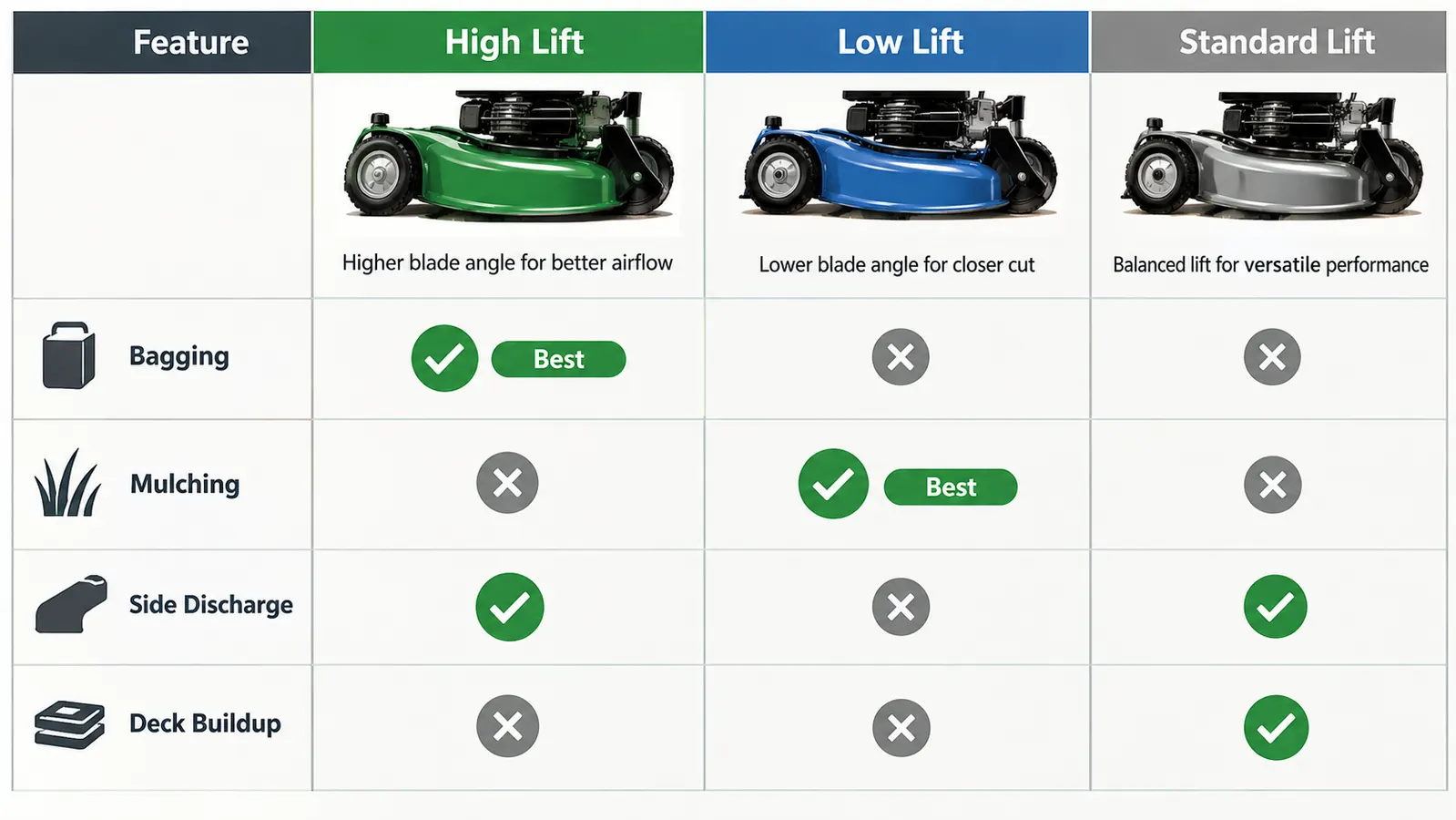
The short answer is this. High lift blades pull more air, which means they stand the grass up and throw it harder out the discharge chute. That makes them the right choice for bagging and for side discharging tall grass. Low lift blades pull less air, which means they cut with less suction and leave the clippings lying more or less where they fall. That makes them the better choice for mulching and for mowing in conditions where you do not want to blow clippings across a driveway or into a flower bed. The blade I keep on my own 54 inch zero turn at home is a high lift set from UDC Parts, and I will walk you through why.
The high lift set I run on my own 54 inch zero turn
UDC Parts makes a direct replacement high lift blade set for 54 inch decks that take the 532187256 five point star pattern, and it has held up through a full season on my mower at home. If you want better bagging and cleaner side discharge, this is the set to start with.
Amazon Check Today's Price on Amazon →How I Tested These Blades
I did not test these blades in a lab. I tested them the way you will use them. I ran a high lift set from UDC Parts on my own 54 inch zero turn for a full season of St. Augustine and Bermuda, cutting about two and a half acres every week from early spring through late fall. I also ran a standard low lift set on the same deck for part of that season, and I kept the same mower, the same deck height, and the same cutting pattern so the only variable was the blade.
I checked four things on every cut. First, how full the bag got and whether the clippings packed down or just sat loose. Second, how the grass looked after side discharging, whether it laid down in clumps or spread out evenly. Third, how much buildup was left under the deck when I flipped it up to wash it. Fourth, how the mower felt, whether the engine lugged on thick grass or pulled through clean. I also paid attention to how often I had to sharpen each set, because a blade that needs sharpening every two cuts is not saving you anything.
For the test I ran both styles on my own 54 inch zero turn at home, on the same two and a half acres of St. Augustine and Bermuda, at the same 3.5 inch cutting height and full throttle. I ran the UDC Parts high lift set for three weeks in late spring, swapped to a standard low lift set I had on the shelf at the shop for the next three weeks, and then swapped back. Mowing the same ground on the same schedule is the only fair way I know to compare blades, because grass changes week to week and you want each blade to see good weeks and bad ones. I mowed every five to seven days, which is about what most of my customers do in the growing season.
One thing I want to be clear about. I am not a sponsored reviewer and UDC Parts did not pay me to write this. I bought the high lift set the same way you would, and I am writing this because customers at the shop ask me the same question every spring: which blade should I run? This is the answer I give them.
| UDC Parts High Lift | Standard Low Lift | |
|---|---|---|
| Bagging | Strong suction packs the bag full and keeps clippings moving | Weak suction leaves the bag half full and clippings settle loose |
| Mulching | Throws clippings out instead of recutting them, so mulch is coarse | Keeps clippings under the deck and recuts them into fine mulch |
| Side discharge | Throws clippings in a wide, even pattern across the lawn | Drops clippings in a narrow row that can clump in thick grass |
| Deck buildup | Airflow keeps the underside of the deck cleaner between washes | Less airflow lets wet clippings pack under the deck faster |
| Engine load | More air means more drag, so the engine works a little harder | Less air means less drag, so the engine pulls through thick grass easier |
| Best for | Bagging, tall grass, and yards with lots of leaves in the fall | Mulching every cut and mowing dry, thin grass |
Where UDC Parts High Lift Blades Win
The high lift blade wins the moment you attach a bagger. That is not a subtle difference. With a low lift blade, my bag would fill maybe two thirds full before the clippings stopped moving and the blower just sat there churning. With the UDC Parts high lift set, the bag packs tight right to the top, and I can mow the whole yard without stopping to empty it as often. If you bag your lawn, high lift is not a preference. It is the difference between a chore that takes an hour and a chore that takes an hour and a half.
On my lawn, the bagger told the whole story. With the low lift set, the front of the hopper filled and the back stayed half empty, so I was stopping to dump a bag that was not really full. With the UDC Parts high lift blades the clippings packed all the way to the back, and I went from emptying the bags about nine times on a full cut down to six. Each stop on a zero turn means climbing off, unhooking the bags and walking them to the compost pile, so three fewer stops took a real chunk out of a Saturday. The chute also stayed clear. I had one clog in three weeks of high lift mowing and four in three weeks with the low lift set.
High lift blades also win on side discharge and on deck cleanliness. The extra air they pull stands the grass up before the cut, so the blade shears it clean instead of tearing it, and the clippings get thrown out in a wide even pattern instead of a clumpy row. That same airflow keeps the underside of the deck cleaner, which matters more than most people think. A deck caked with wet clippings robs you of lift, and a deck that stays clean keeps cutting the way it did the first time you used it. On my mower at home, the UDC Parts high lift set kept the deck noticeably cleaner between washes than the low lift set did.
Where Standard Low Lift Blades Win
Low lift blades win when you mulch every single cut. Mulching requires the clippings to stay under the deck long enough to get recut into fine pieces, and a high lift blade does the opposite of that. It throws the clippings out before they can be recut, so you end up with coarse clumps of grass sitting on top of the lawn instead of fine mulch breaking down into the soil. If your mower has a dedicated mulching deck and you never attach a bagger, a low lift blade is the honest answer. I run high lift on my own mower because I bag in the spring and fall, but I tell customers who mulch year round to stay with low lift.
I saw this myself on the weeks I ran the mulch plate. The low lift set kept clippings circulating under the deck long enough to chop them fine, and two days later you could not find them in the turf. The high lift blades pushed the clippings back out before they were chopped as fine, and I could see small green clumps sitting on top of the St. Augustine after a thick cut. If mulching is your whole plan, that is a real difference, not a matter of taste. It is also why I tell customers who mulch exclusively to buy a true mulching or low lift blade instead of trying to make a high lift blade do a job it was not shaped for.
Low lift blades also win on engine load and on dry, thin grass. Because they pull less air, they put less drag on the engine, which matters on a residential zero turn when you are cutting thick St. Augustine in July. The mower pulls through without lugging, and the cut stays consistent. On dry, thin grass, high lift blades can actually do more harm than good, because they pull up so much air that they suck the dry grass up and blow it across the yard in a dusty cloud. Low lift blades keep the clippings closer to the ground where they belong. If your grass is thin and your yard is dry, low lift is the better tool.
You can hear the difference in the engine. In the thick St. Augustine along the front ditch, the high lift blades pulled the RPM down noticeably on the first pass and I slowed my ground speed to keep the cut clean. The low lift set barely changed the engine note in the same strip. On a smaller engine, or on an older mower that has lost some compression, that extra load can be the difference between a clean cut and a bogged down one. If your mower already struggles in tall grass, the low lift blade is the easier choice for the engine. If your engine has power to spare, the UDC Parts high lift set puts that power to work moving clippings.
Run high lift if you bag or side discharge. Run low lift if you mulch.
For most 54 inch zero turn owners, the UDC Parts high lift set is the better daily blade. It bags better, side discharges better, and keeps the deck cleaner. If you mulch every cut, keep a low lift set on hand and swap when the season changes.
Amazon Check Today's Price on Amazon →Who Should Buy Which
Buy the UDC Parts high lift blades if you bag your lawn, if you side discharge into tall grass, or if you mow a yard with a lot of leaves in the fall. That covers most homeowners with a 54 inch zero turn, and it covers me. The high lift set from UDC Parts is a direct replacement for factory blades on 54 inch decks with the 532187256 five point star pattern, the fit is right, and the steel has held up through a full season on my mower at home without bending or losing its edge any faster than the factory set.
Whichever you choose, check the part number against your deck before you order. The UDC Parts set I tested follows the Husqvarna 532187256 pattern with a five point star center hole, and it bolted onto my spindles without any filing or spacers. A blade with the wrong center hole will either not seat or will seat loose, and a loose blade is a safety problem, not a cut quality problem. Your owner's manual or the old blade itself will tell you what you need. Bring the old blade to your dealer's parts counter if you are unsure. We would much rather look at a blade for you than see a mower come back in with a bent spindle.
Buy a standard low lift set if you mulch every single cut and never bag. You will get a finer mulch, a cleaner cut on dry grass, and a little less strain on the engine. The honest truth is that a lot of homeowners would be better off owning both sets and swapping them when the season changes, because the right blade for April is not always the right blade for August. But if you only want to buy one set, and you bag or side discharge at least part of the year, make it high lift.
The high lift set I keep on my 54 inch zero turn
If you bag or side discharge on a 54 inch deck that takes the 532187256 pattern, the UDC Parts high lift set is the blade I would put on next. Check the part number against your deck first.
Amazon Check Today's Price on Amazon →